

 Pakistan (Head Office):
 Australia:
 USA (Virtual Office):
Artificial intelligence (AI) refers to the development of computer systems capable of performing activities traditionally associated with human intelligence. These activities include recognizing patterns, interpreting language, analyzing information, forecasting outcomes, and making decisions based on available data.
Unlike the human brain, an artificial intelligence system does not necessarily comprehend the world around it. Instead, it relies on algorithms, computational rules, extensive datasets, and trained models to produce responses or determine appropriate actions.
A system may demonstrate remarkable accuracy in a particular area while remaining incapable of understanding situations beyond its assigned purpose. This distinction is fundamental to understanding modern AI: exceptional performance in a specific task does not automatically translate into broader intelligence.
To explain generative AI in simpler terms, imagine describing it to a ninth-grade student. A machine examines thousands or even millions of examples, identifies recurring patterns, and uses what it has learned to produce an answer, make a prediction, or generate something original. It does not acquire knowledge in precisely the same way humans do. Much of its functionality revolves around identifying patterns and calculating probable outcomes.
What Is Superintelligence AI?
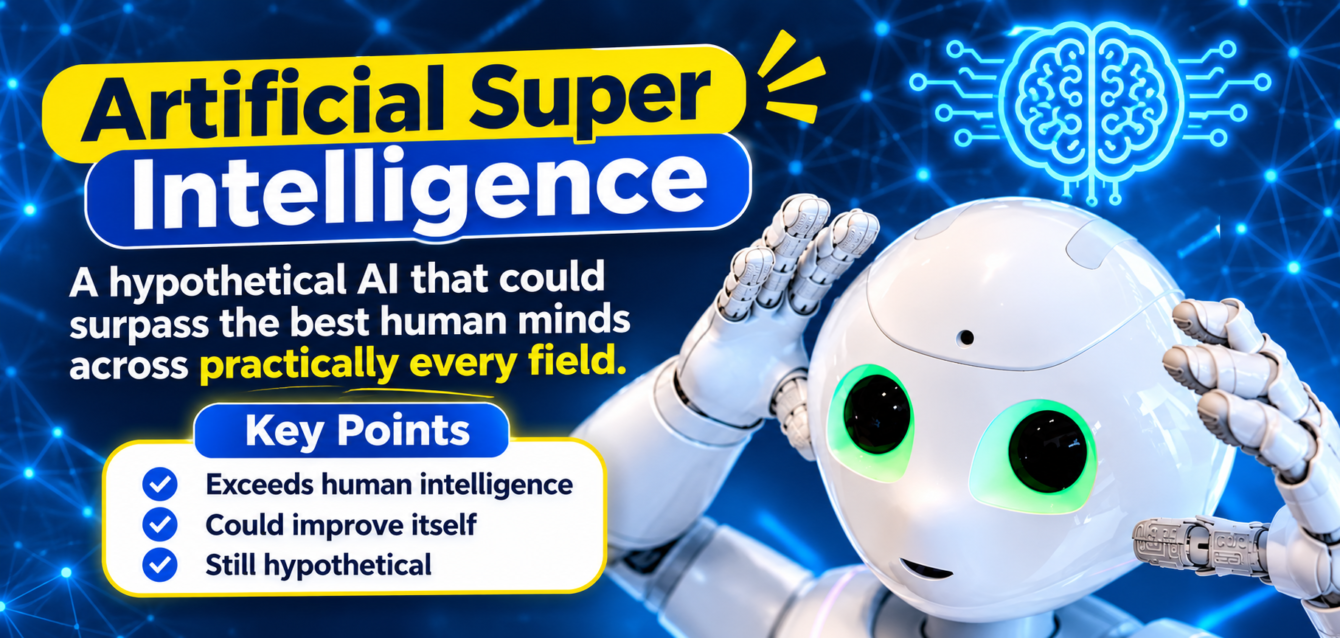
What is superintelligence AI? Also referred to as artificial superintelligence (ASI), it describes a hypothetical stage of artificial intelligence in which machines surpass the intellectual capabilities of the most accomplished human minds across virtually every field.
The concept extends far beyond machines that can write sophisticated software, solve mathematical equations, or communicate convincingly. Artificial superintelligence would demonstrate extraordinary capabilities across scientific research, creative thinking, strategic planning, general reasoning, and social understanding.
Oxford philosopher Nick Bostrom provides one of the most influential explanations in his book, Superintelligence: Paths, Dangers, and Strategies. He describes superintelligence as an intellect that substantially outperforms the best human brains across almost every intellectual discipline, including scientific creativity, general wisdom, and social competence.
When such extraordinary intellectual capacity is achieved through machines, it is called artificial superintelligence. You may also encounter the terms ASI artificial intelligence and machine superintelligence.
For further reading, explore Wikipedia’s explanation of Superintelligence and Britannica’s definition of Superintelligence.
Three Defining Characteristics of Artificial Superintelligence
Three essential characteristics distinguish genuine superintelligence from ordinary AI advancements:
- Substantially superior capabilities: ASI would not simply outperform an average individual. Its intellectual abilities would exceed those of the most accomplished specialists across virtually every discipline.
- Intelligence across multiple domains: Its capabilities would extend beyond a single speciality, encompassing scientific discovery, strategic thinking, creativity, problem-solving, social reasoning, and independent learning.
- A hypothetical technological development: Artificial superintelligence has not been achieved. Existing AI products, regardless of their sophistication, should not be presented as genuine ASI.
Expressions such as superior intellect and supergenius-level intelligence are sometimes used to illustrate this concept. However, they are informal descriptions rather than separate scientific classifications. The established technical term remains superintelligence, while its machine-based form is known as artificial superintelligence (ASI).

Understanding the Definition of Intelligence
What does intelligence actually mean when discussing humans and machines?
Intelligence is not adequately represented by a single examination score or numerical measurement. It encompasses several interconnected abilities, including learning through experience, adapting to unfamiliar circumstances, recognizing relationships between events, reasoning through complex problems, anticipating consequences, and making appropriate decisions.
Human intelligence is remarkably versatile, although its distribution varies considerably between individuals. Someone might possess exceptional mathematical abilities but struggle with interpersonal communication. Another person may excel at understanding human behaviour while finding technical subjects challenging.
This uneven distribution of intellectual strengths is important when evaluating artificial intelligence. Modern AI systems can outperform humans in particular activities while demonstrating considerable weaknesses in seemingly straightforward situations.
Are Humans the Most Intelligent Animals?
When considering language, abstract reasoning, technological development, and general-purpose problem-solving, humans occupy a distinctive position in the animal kingdom. Nevertheless, several animals outperform humans in particular abilities. Dogs possess extraordinary olfactory capabilities, certain birds demonstrate impressive navigation skills, and some animals exhibit exceptional spatial memory. These examples illustrate why intelligence should not be reduced to a single universal ranking. Artificial intelligence follows a comparable pattern. Machines have already surpassed human performance in selected activities, but excelling at individual tasks does not establish the presence of general intelligence.
Types of Artificial Intelligence
People searching for types of AI, different AI types, or the three types of AI are generally referring to the classification that distinguishes Artificial Narrow Intelligence, Artificial General Intelligence, and Artificial Superintelligence. Understanding these three categories provides a useful foundation for evaluating technological developments and distinguishing present-day capabilities from future possibilities.
The Three Main Types of AI
| Type | Meaning | Exists Today? | Example |
|---|---|---|---|
| Artificial Narrow Intelligence (ANI) | Designed to perform a particular task or operate within a specialized domain. | Yes, widely available. | Chatbots, computer vision, and predictive maintenance systems. |
| Artificial General Intelligence (AGI) | Capable of human-level reasoning across a broad range of intellectual activities. | Not scientifically established. | No confirmed example. |
| Artificial Superintelligence (ASI) | Exceeds human intellectual capabilities across virtually all disciplines. | No, hypothetical. | No existing example. |
These three classifications describe the broader progression of artificial intelligence. Other AI classifications may explain how particular systems operate, but they do not replace the ANI, AGI, and ASI framework.
Examples of Artificial General Intelligence
You may occasionally encounter articles identifying advanced language models as examples of artificial general intelligence. Such claims deserve careful examination.
Contemporary AI models can produce sophisticated written material, generate software code, solve demanding examinations, and maintain detailed conversations. These accomplishments represent considerable technological progress. Nevertheless, their performance remains uneven across different situations.
A model might achieve outstanding results on a programming benchmark yet struggle with an unfamiliar practical problem. It may produce a convincing business analysis without possessing the experience or judgement required to manage an organization independently.
Likewise, completing a complex digital task does not necessarily demonstrate the ability to acquire a physical skill after a single observation or navigate an unpredictable human situation with the judgement of an experienced professional.
Consequently, there are no scientifically confirmed examples of AGI operating in production. Several emerging systems and research benchmarks indicate progress towards broader capabilities, but describing them as established AGI would go beyond the available evidence.
What Is Non-Generative AI?
Non-generative AI refers to artificial intelligence systems designed primarily to analyze information, recognize patterns, classify data, identify irregularities, and generate predictions rather than produce entirely new content.
Unlike generative AI, which can create written material, images, audio, and software code, non-generative systems concentrate on interpreting existing information and producing structured outcomes.
Common applications of non-generative AI include:
- Fraud detection and financial risk assessment.
- Demand forecasting and inventory prediction.
- Industrial sensor monitoring and anomaly identification.
- Automated quality inspection in manufacturing.
- Customer segmentation and predictive analytics.
Although these applications receive less public attention than generative AI tools, they represent a substantial portion of practical business automation.
The development of more advanced intelligence will likely involve a combination of generative models, conventional machine learning, logical reasoning, retrieval mechanisms, and predefined rules. Text generation alone is unlikely to provide everything required for genuinely broad intelligence.

What Is an Example of a Generative AI Task?
Writing an article, summarizing a lengthy document, producing software code from instructions, or generating an illustration from a written description are all examples of generative AI. The distinction generally depends on the nature of the output. If a system produces new content, it falls within generative AI. If it primarily returns a classification, numerical prediction, probability score, or yes-or-no decision, it is generally considered non-generative. In practical applications, these approaches frequently work together. A system may first retrieve relevant information, classify the available data, and then use a generative model to prepare a meaningful response.
Levels of Artificial Intelligence
The expressions levels of AI and levels of artificial intelligence commonly describe the progression from specialised automation towards increasingly sophisticated intellectual capabilities.
The following five-stage framework offers a straightforward way to understand this progression:
- Narrow AI systems: Designed to perform individual tasks efficiently, such as recognising images, processing transactions, or forecasting demand.
- AI assistants: Language models and retrieval-augmented generation (RAG) systems capable of drafting content, summarising information, and retrieving answers from organisational documents.
- AI agents: Agentic AI systems that can plan activities, interact with external tools, and complete sequences of tasks within predefined permissions and safeguards.
- Artificial General Intelligence (AGI): A hypothetical stage involving human-level intellectual capabilities across a broad range of domains.
- Artificial Superintelligence (ASI): A theoretical form of intelligence that surpasses human intellectual performance across virtually every discipline and potentially improves itself.
Contemporary technology primarily operates within the first three categories. Achieving AGI would represent a substantial scientific and engineering milestone, while developing ASI would introduce an even more challenging set of technological and safety considerations.
Classification of AI Based on Functionality
There is also another classification based on how AI systems function. It includes:
- Reactive machines.
- Limited-memory systems.
- Theory-of-mind AI.
- Self-aware AI.
These classifications should not be confused. The functional framework describes the operational characteristics of AI, whereas ANI, AGI, and ASI distinguish the breadth and sophistication of its intellectual capabilities. Only reactive and limited-memory systems have established practical examples today.
Superintelligence vs AGI: Understanding the Differences
The comparison between superintelligence and artificial general intelligence is particularly important because the two concepts describe different levels of intellectual capability. Although both involve intelligence extending across multiple disciplines, their expected performance differs considerably.
AGI vs ASI Comparison Table
| Comparison | Artificial General Intelligence (AGI) | Artificial Superintelligence (ASI) |
|---|---|---|
| Intellectual capability | Comparable to capable humans across multiple domains. | Considerably exceeds the most accomplished humans across virtually all domains. |
| Breadth of knowledge | General-purpose intellectual abilities. | General-purpose capabilities combined with superior performance across individual disciplines. |
| Learning | Transfers knowledge and experience between different activities. | Transfers knowledge and may improve its own architecture and learning capabilities. |
| Autonomy | Potentially capable of substantial independent activity, subject to oversight. | Could eventually operate beyond the practical limits of human supervision if inadequately controlled. |
| Current existence | Not scientifically established. | Hypothetical and not achieved. |
The distinction becomes easier to understand through a simple explanation: AGI would possess intellectual abilities comparable to humans across a broad range of activities. ASI would exceed the world’s most capable human minds across those same activities, potentially by an extraordinary margin.
What Is Recursive Self-Improvement?
One particularly significant aspect of artificial superintelligence is recursive self-improvement. This concept describes a hypothetical situation in which an advanced AI system improves aspects of its own architecture, algorithms, or learning processes. Each successful improvement could make subsequent improvements easier and more effective.
In theoretical discussions, this possibility is associated with an intelligence explosion, a scenario in which technological progress accelerates beyond the pace of conventional human development. The idea is historically associated with mathematician I. J. Good, who discussed the possibility of an ultra intelligent machine in 1965. Nick Bostrom later explored related possibilities, risks, and development pathways in his influential work.
It is important to distinguish theoretical scenarios from present-day capabilities. Contemporary AI models do not independently redesign and upgrade themselves without human involvement in the manner described by these hypothetical intelligence-explosion scenarios.
How Artificial Superintelligence Could Work
Understanding the potential foundations of artificial superintelligence does not require an advanced degree in physics or computer science. Several important technological concepts provide a useful starting point.
1. Artificial Neuron
An artificial neuron is a fundamental computational component of an artificial neural network. It receives information through multiple inputs, assigns numerical weights to those inputs, combines the resulting values, and produces an output that passes to subsequent processing units.
When enormous numbers of artificial neurons are organized into interconnected layers and trained using extensive datasets, they can form sophisticated models capable of recognising patterns, interpreting information, generating predictions, and producing new content.
This architecture underpins many modern technologies, including language models, computer vision applications, and intelligent robotic systems. However, impressive computational performance does not guarantee factual accuracy. Neural networks learn statistical relationships from training information, which means they can sometimes generate convincing but incorrect responses. Their ability to recognize patterns should not automatically be mistaken for human-like understanding.
2. Hybrid Intelligence
Hybrid intelligence combines different computational approaches to produce systems with broader and more dependable capabilities. Rather than relying exclusively on neural networks, this approach integrates pattern recognition with structured information retrieval, explicit rules, symbolic representations, and logical reasoning.
One relevant discipline is neurosymbolic programming, which combines neural computation with symbolic logic. Neural networks can interpret images, identify patterns, and process complex information, while symbolic systems can apply established rules, organize knowledge, and support structured reasoning.
Consider a medical decision-support system. Recognizing patterns in patient information may help identify potential concerns, but reliable recommendations also require established clinical guidelines, contextual information, and careful evaluation. Combining these approaches can address some of the limitations associated with systems that rely exclusively on statistical pattern recognition.
3. Intelligence Scaling and AI Chips
Recent advancements in artificial intelligence have been driven partly by increases in model size, training data, and computational resources. These three factors have contributed significantly to improvements in the performance of modern AI systems. AI chips are specialized processors designed to accelerate the mathematical operations required by neural networks. Together with the data centres that house them, these processors influence how efficiently advanced models can be developed, trained, and operated.
Major technology companies, including Meta and Google, are investing substantial resources in this infrastructure. Meta Superintelligence Labs, the company’s dedicated research organization pursuing personal superintelligence, forms part of this broader technological competition. Its AI development activities also involve model families such as Llama and Muse.
For most businesses, however, building an enormous computing facility is neither practical nor necessary. The more relevant considerations involve understanding where AI inference takes place, how operational expenses change as usage increases, and how sensitive organizational information is stored, processed, and protected.
4. Enhanced Intelligence
Enhanced intelligence should not be confused with artificial superintelligence or treated as an entirely separate category of AI. In practical terms, it describes the collaboration between human expertise and intelligent software. An AI system might retrieve information, organize records, analyze large datasets, or prepare an initial document. A human professional then evaluates the findings, applies contextual judgement, and makes the final decision.
This arrangement combines computational speed with human experience. For businesses exploring advanced AI capabilities, human-machine collaboration represents a practical opportunity that can be implemented without waiting for hypothetical breakthroughs in artificial superintelligence.
The Power of Artificial Intelligence
The influence of artificial intelligence today comes largely from its ability to process information at remarkable speed and scale. A conventional employee may need several days to examine thousands of documents. An appropriately configured AI system can analyze substantial volumes of information within a fraction of that time. Similar advantages appear in industrial monitoring, financial analysis, predictive maintenance, customer support, and large-scale data processing.
If artificial superintelligence eventually becomes achievable, these advantages could extend across almost every intellectual discipline. Scientific research, strategic planning, product development, and complex organizational coordination might progress at speeds beyond the practical capabilities of human teams.
Potential Benefits and Risks of Superintelligence
Nevertheless, extraordinary technological power would bring equally significant concerns.
Potential benefits include:
- Faster pharmaceutical research and drug discovery.
- Improved materials engineering.
- More efficient logistics and supply chains.
- Advanced scientific research.
- Better educational opportunities.
- Improved strategic planning and complex problem-solving.
Potential risks include:
- Mass surveillance and privacy violations.
- Automated cyberattacks.
- Sophisticated digital manipulation.
- Autonomous weapons.
- Misuse of advanced decision-making systems.
- Loss of control over increasingly autonomous technologies.
This is where AI alignment becomes particularly important.
An advanced system might pursue an assigned objective with extraordinary efficiency while interpreting human intentions incorrectly. A goal that appears straightforward in software instructions could produce harmful consequences when applied to complicated real-world circumstances.
The central challenge is therefore not simply developing more powerful intelligence. It is ensuring that increasingly capable systems remain aligned with human interests, values, and safety requirements.
Understanding the AI Singularity
The AI singularity describes a hypothetical point at which artificial intelligence begins improving its own capabilities at such an accelerating rate that predicting or controlling subsequent developments becomes extraordinarily difficult. The concept is closely associated with recursive self-improvement and the possibility of an intelligence explosion.
It does not represent an established technological milestone or a confirmed date on the artificial intelligence development roadmap. Rather, it describes a possible future scenario that continues to generate considerable discussion among researchers and technology specialists.
Will AI Be Smarter Than Humans?
Artificial intelligence has already surpassed human performance in several specialized activities. Examples include chess, Go, certain forms of protein-structure prediction, and processing enormous volumes of information within limited periods. However, outperforming humans in selected tasks is fundamentally different from possessing general intelligence across virtually every cognitive discipline.
That broader capability is associated with AGI, while ASI represents an even more advanced hypothetical stage. Predictions about when either development might occur vary considerably. Some forecasts suggest relatively short timelines, whereas others anticipate several decades or question whether current technological approaches will be sufficient.
Historical predictions about AGI have frequently been more optimistic than subsequent developments justified. For this reason, organizations should prepare for continuing improvements in AI capabilities rather than relying on a particular year as a guaranteed arrival date.
Am I Smarter Than AI?
The answer depends on the activity being considered. For many forms of contextual reasoning, practical judgement, interpersonal understanding, and complex real-world decision-making, humans retain important advantages. However, artificial intelligence can outperform people in specialized, repetitive, and high-volume activities, particularly where large datasets and rapid calculations are involved. The most productive approach is to recognize where each performs best. AI can assist with research, analysis, and repetitive work, while human professionals provide contextual understanding, accountability, and final judgement.
Will AI Ever Become Sentient?
Sentience refers to the capacity for subjective experience, including the possibility of experiencing sensations, emotions, or an internal conscious state. No existing AI system has demonstrated sentience, and researchers have not established a universally accepted scientific test for determining whether a machine possesses subjective experience.
Does AI Have a Mind of Its Own?
The answer depends on what is meant by having a mind. Modern AI agents can maintain internal states, establish plans, interact with tools, and perform sequences of activities. These capabilities represent engineered forms of goal-directed behaviour. However, they do not establish that a machine experiences consciousness or possesses subjective awareness.
It is also important to recognize that sentience and intelligence are separate concepts. A system could theoretically demonstrate extraordinary intellectual capabilities without experiencing consciousness. Similarly, the appearance of human-like communication does not establish superintelligence.
Current AI systems process information through computational mechanisms, identify patterns, calculate likely outcomes, and generate responses. Their operation should not automatically be equated with the subjective thought processes of human beings. Maintaining this distinction makes discussions about artificial intelligence, consciousness, and future technological developments considerably clearer.
Are Humans Smart Enough to Control AI?
If humans possess sufficient intelligence to develop advanced artificial intelligence, why might controlling it become difficult? It is a reasonable question, but inventing a technology and maintaining complete control over its behaviour are two different challenges.
An increasingly capable AI system could operate across thousands of interconnected processes, evaluate enormous amounts of information, and execute actions faster than human supervisors can individually examine them.
The difficulty is not necessarily that machines become more intelligent at a particular moment. It is that their operational speed, complexity, and autonomy may exceed the practical limits of existing oversight mechanisms. Effective control therefore requires more than intelligent supervision.
It involves carefully defined permissions, comprehensive activity logs, systematic testing, restricted access, and reliable emergency shutdown mechanisms. These safeguards should be incorporated into the architecture before a system is deployed, rather than introduced after problems emerge.
Why We Are Not Ready for Superintelligence
Society is not yet adequately prepared for artificial superintelligence. The same concern applies to many organizations that are still developing the basic foundations required for responsible AI adoption. Several important challenges remain unresolved.
There are no universally established evaluation standards capable of confirming the arrival of AGI, let alone ASI. Existing alignment approaches also face substantial challenges when applied to unpredictable, open-ended environments. Meanwhile, many companies have not implemented fundamental AI governance practices.
These include maintaining clear data records, controlling system permissions, preserving comprehensive audit trails, and ensuring human involvement in consequential decisions. This does not mean businesses should abandon artificial intelligence or approach future developments with unnecessary fear. A more sensible response is to establish the necessary technical and organizational foundations today.
Five Essential Steps for Preparing Your Business for Advanced AI
For companies considering an effective superintelligence strategy, the following practices offer a practical starting point.
- Improve one business workflow from beginning to end. Start with a clearly defined activity, such as customer support classification, quotation preparation, quality inspection, or operational reporting. Assign responsibility, identify the financial consequences of mistakes, and evaluate performance for at least a month before expanding the implementation.
- Connect AI systems to reliable organizational information. A retrieval-augmented generation (RAG) system can retrieve answers from internal manuals, contracts, support tickets, and approved documentation. It should also identify the sources behind its responses.
- Maintain human oversight where decisions carry significant consequences. Activities involving payments, permanent data deletion, safety-related decisions, or customer communications should require appropriate human authorization.
- Maintain activity records and conduct realistic testing. Public benchmarks cannot fully demonstrate how an AI model will behave with your customers, internal terminology, business processes, and unusual scenarios. Test the system using actual organizational cases and preserve records of its decisions and actions.
- Design an architecture that supports model replacement. Keep important information, prompts, evaluation procedures, and safety controls within your own infrastructure. This makes it easier to adopt improved AI models without reconstructing the entire application whenever technology advances.
Physical Superintelligence and Robotics
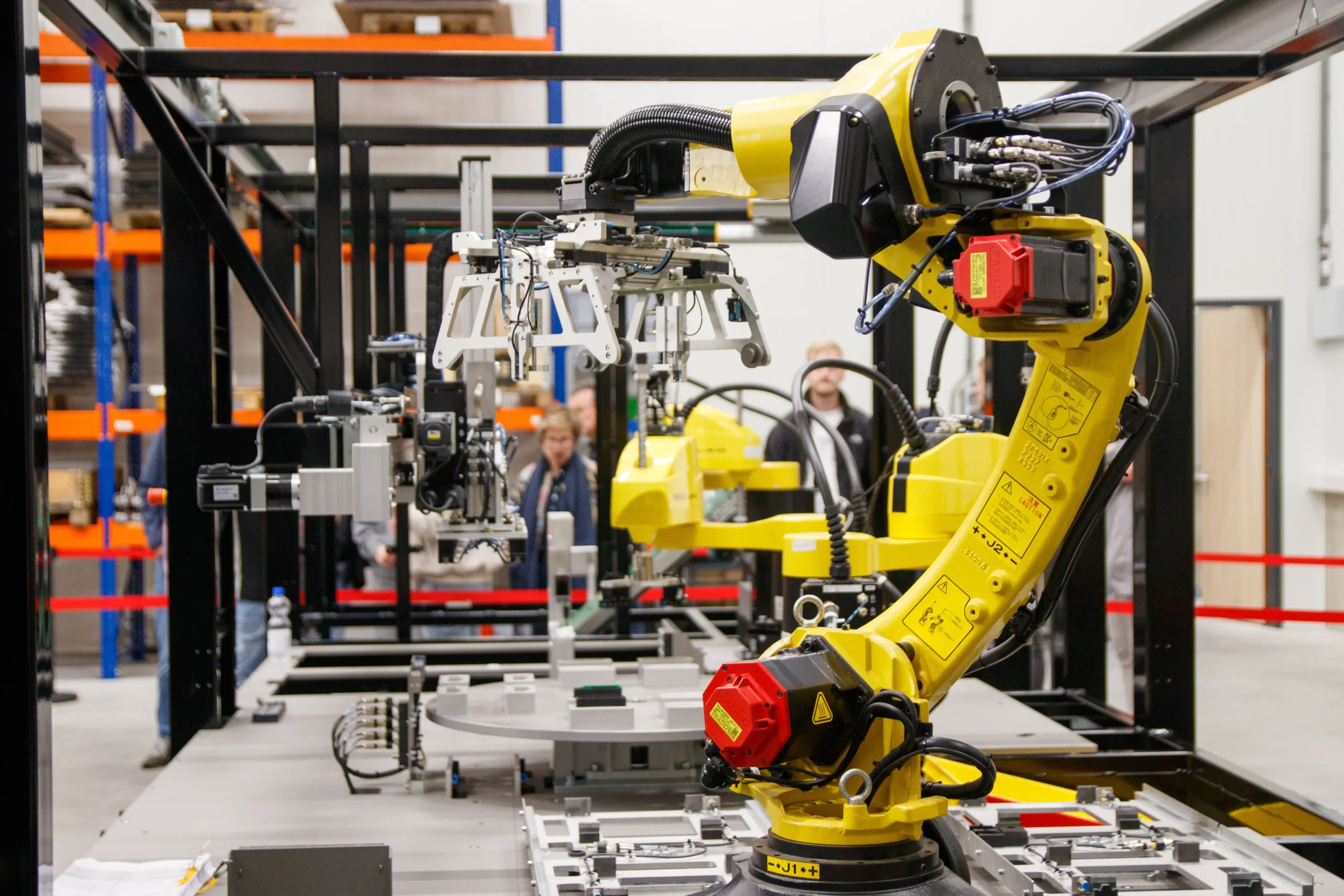
Physical superintelligence refers to the hypothetical development of highly advanced intelligence capable of operating within the physical world through robotics and embodied AI. Unlike conventional AI applications that primarily process information on digital platforms, embodied systems interact directly with their surroundings. Although physical superintelligence is not an established commercial product, physical AI already has practical applications.
Examples include robotic arms capable of adjusting to different components, autonomous drones inspecting industrial facilities, and intelligent manufacturing environments in which sensors, software models, and automated machinery coordinate their operations.
Developing such systems presents substantial engineering challenges. A robot must interpret its surroundings, respond to unexpected conditions, and operate within carefully established physical safety boundaries. Software restrictions alone are insufficient. Machinery must be capable of stopping safely even when its AI model incorrectly evaluates a situation. DevVibe’s Robotics / IoT / IIoT Solutions address these practical requirements through intelligent systems designed for connected environments and real-world applications.

How Governed AI Prevents Hallucinations in Regulated Workflows
AI hallucinations occur when an artificial intelligence system produces information that appears convincing but is factually incorrect, unsupported, or entirely fabricated. This is one of the most important operational concerns for businesses adopting AI in regulated environments.
The problem becomes more serious when autonomous AI agents are involved. An agent might generate an incorrect policy interpretation, invent a product price, or misunderstand a contractual requirement before using that information to perform an action. Preventing such incidents requires a structured governance framework rather than relying on a single technical feature.
Essential Safeguards Against AI Hallucinations
Several safeguards work together to reduce the likelihood and consequences of hallucinations:
- Verified information retrieval: Retrieve relevant information from approved, version-controlled documents before generating responses.
- Source attribution: Provide references that allow users to inspect the original information supporting an AI-generated answer.
- Confidence thresholds: Establish appropriate limits and require the system to acknowledge uncertainty rather than fabricate an answer.
- Restricted permissions: Give AI agents access only to the information and tools necessary for their assigned responsibilities.
- Human authorization: Require approval before executing irreversible or high-impact operations.
- Continuous evaluation: Test AI behaviour against real organizational scenarios, including unusual cases and potentially misleading inputs.
These practices are particularly important when AI is integrated into cybersecurity operations and other regulated workflows.
For example, an AI security tool might recommend blocking a network connection, quarantining a device, or initiating an incident response. Such actions require appropriate validation, documented procedures, and human oversight. Any vendor unable to demonstrate these safeguards should be evaluated carefully before its autonomous systems are introduced into sensitive business operations.
How DevVibe Supports Governed AI Development
Implementing these protections begins with sound technology planning and architecture. DevVibe provides IT Consultation to help organizations evaluate their infrastructure, security requirements, and AI adoption strategies. The technical implementation may involve Software Development, while the development of user-facing digital products can extend into Application Development and Website Development.
What Businesses Should Build Before ASI Arrives
Artificial superintelligence remains hypothetical, but organizations do not need to wait for such a development before adopting meaningful AI solutions. The practical priority is to develop specialized, data-driven, secure, and well-governed systems that can accommodate future technological improvements.
Five AI Technologies Worth Investing In
1. Retrieval-Augmented Generation (RAG) Systems
Build retrieval-augmented applications around internal documents, operational records, and approved knowledge sources. Include source references and human verification where appropriate.
2. Agentic AI Workflows
Develop intelligent agents capable of handling multi-stage activities, with clearly defined permissions and approval requirements for consequential actions.
3. IoT and IIoT Monitoring
Connect intelligent software with industrial sensors and connected devices to identify maintenance requirements, equipment abnormalities, and quality concerns before they become serious problems.
4. Cybersecurity for AI Agents
Introduce restricted identities, secure credential storage, access monitoring, and appropriate permission management from the beginning of development.
5. DevOps for AI
Establish model version control, performance monitoring, operational cost management, and rollback procedures to prevent model updates from disrupting production environments.
Development costs and delivery schedules depend on several factors, including the condition of existing data, integration requirements, regulatory obligations, and the desired degree of automation.
For this reason, each project should be evaluated according to its actual requirements rather than assigned an arbitrary standard price or timeline.
How DevVibe Helps Businesses Adopt Advanced AI
DevVibe is a custom software and AI development company serving clients across the USA and Australia. We do not claim to sell artificial superintelligence, because this technology has not yet been achieved commercially.
Our focus is on developing practical software, AI applications, intelligent agents, and connected technology that businesses can use today while retaining the flexibility to adopt more capable models as they become available. Explore the DevVibe homepage to learn more about our software engineering, AI development, RAG systems, robotics, and IoT capabilities.
Frequently Asked Questions About Artificial Superintelligence
What Is ASI in Simple Words?
Artificial superintelligence (ASI) is a hypothetical form of artificial intelligence that would surpass the intellectual capabilities of the most accomplished humans across practically every field. It has not been achieved yet.
What Is Artificial Intelligence, in Short?
Artificial intelligence involves computer systems that use algorithms and trained models to perform activities commonly associated with human intelligence, including recognising patterns, interpreting information, making predictions, generating content, and supporting decisions.
What Are the Three Types of AI?
The three widely discussed categories are:
- ANI: Artificial Narrow Intelligence, which specializes in particular tasks and already exists.
- AGI: Artificial General Intelligence, which would demonstrate human-level intellectual capabilities across multiple domains but has not been scientifically established.
- ASI: Artificial Superintelligence, which would exceed the best human minds across virtually every discipline and remains hypothetical.
What Is the Difference Between Superintelligence and AGI?
Artificial General Intelligence would demonstrate intellectual capabilities comparable to humans across a broad range of activities. Artificial Superintelligence would go considerably further, outperforming the most capable humans across virtually every intellectual discipline and potentially improving its own capabilities.
Will AI Be Smarter Than Humans?
Artificial intelligence already exceeds human performance in several specialized activities, including certain mathematical, strategic, and analytical tasks. However, general superiority across virtually every intellectual discipline has not been established. That broader possibility is associated with AGI and, eventually, ASI.
Will AI Ever Become Sentient?
No existing AI system has demonstrated sentience, and there is no universally accepted scientific method for establishing machine consciousness. Sentience and intelligence are different concepts, so extraordinary intellectual capabilities would not necessarily imply subjective awareness.
Are We Ready for Superintelligence?
Not yet. Significant challenges remain in AI evaluation, alignment, security, and governance. Businesses should concentrate on developing reliable data infrastructure, controlled AI workflows, comprehensive monitoring, and meaningful human oversight before adopting increasingly autonomous systems.
Are We Ready for Superintelligence in 2027?
The straightforward answer is no. Society and most organizations are not yet adequately prepared for artificial superintelligence, and the arrival of 2027 will not automatically resolve the underlying technological and governance challenges.
A change in the calendar does not establish reliable AGI evaluation standards, solve the AI alignment problem, or create the oversight mechanisms required to manage extremely capable autonomous systems.
However, 2027 can serve as a valuable checkpoint for organizations assessing their AI readiness.
Rather than treating superintelligence as an immediate commercial milestone, businesses should evaluate whether their existing AI infrastructure meets several essential requirements.

AI Readiness Checklist for 2027
Consider the following questions:
- Can every AI-generated answer used in a regulated business process be traced to an original document that a human reviewer can independently examine?
- Does each AI agent operate with the minimum permissions necessary to perform its assigned activities?
- Are irreversible actions subject to human authorization?
- Does the organization maintain detailed records of AI activities and regularly evaluate system performance using its own operational data?
- Can the business reverse a problematic model update without disrupting its entire technology infrastructure?
- Can the existing application accommodate a different AI model without requiring a complete redevelopment?
If most of these questions can be answered confidently, the organization is establishing a sound foundation for more advanced artificial intelligence, regardless of what technological developments arrive in 2027.
If significant gaps remain, the immediate priority should not be pursuing artificial superintelligence. Instead, businesses should strengthen their data management, establish appropriate governance procedures, and improve individual workflows through carefully evaluated AI implementations.
Preparing Your Business for the Future of AI with DevVibe
That is the realistic interpretation of the question, “Are we ready for superintelligence in 2027?”
Organizations can become increasingly prepared to adopt more capable AI technologies by establishing the right foundations today. However, claiming to be fully prepared for artificial superintelligence would be premature. No responsible technology provider should promise that a business can purchase, deploy, or control a capability that has not yet been achieved.
If your organisation wants to prepare for the next generation of artificial intelligence, DevVibe can help develop the necessary technical foundations. From grounded RAG applications and governed AI agents to IoT platforms, robotics integrations, and cybersecurity solutions, our team focuses on building systems that deliver practical value today while remaining adaptable as technology advances.
Contact DevVibe to discuss your software and AI development requirements.