


 Pakistan (Head Office):
 Australia:
 USA (Virtual Office):

Imagine a business owner exploring the latest artificial intelligence technologies. One application drafts professional emails, another handles customer enquiries, while a third identifies manufacturing defects with remarkable precision. Each tool performs its assigned function impressively. Yet none possesses a comprehensive understanding of how the entire business operates.
Eventually, a bigger question emerges: If artificial intelligence continues advancing at this pace, could it eventually develop intelligence comparable to human beings? And if that happens, what would prevent it from becoming significantly more intelligent than humanity itself? This is where the concepts of Artificial General Intelligence (AGI) and Artificial Superintelligence (ASI) enter the discussion.
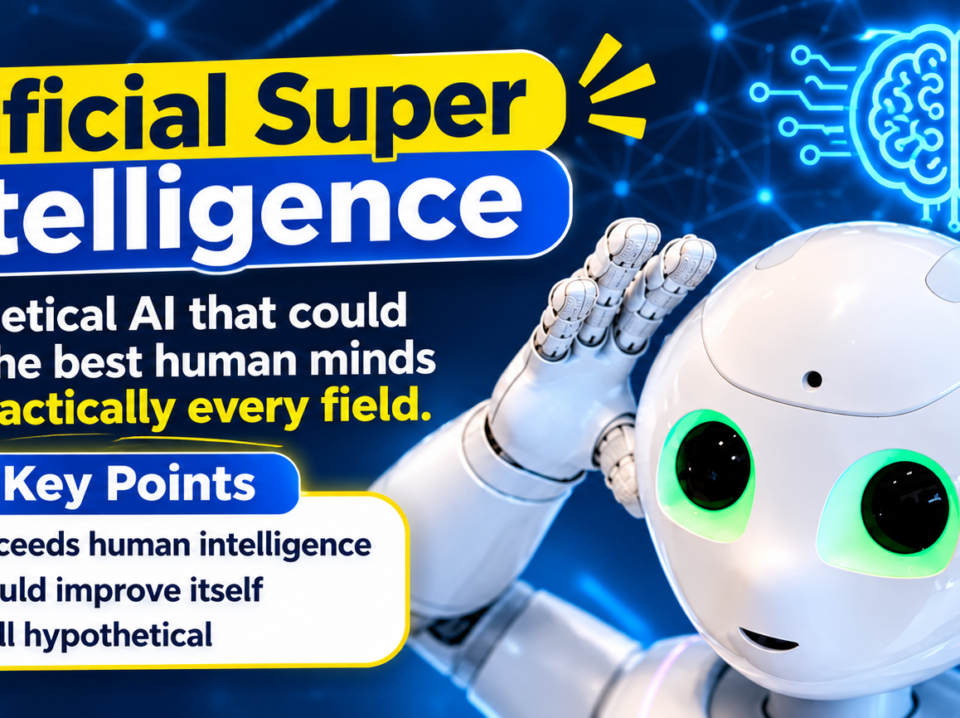
AGI represents a hypothetical form of intelligence capable of performing virtually every cognitive task that humans can undertake. ASI takes the concept considerably further, describing an intelligence that surpasses human capabilities across almost every intellectual discipline. Neither has been achieved. Nevertheless, the possible transition from AGI to ASI raises fascinating questions about technological progress, scientific discovery, business transformation, and humanity’s relationship with increasingly capable machines. Understanding this progression is essential for distinguishing genuine technological developments from exaggerated predictions about the future of AI.
The Reality of Today’s AI: Why Narrow Intelligence Is Often Misunderstood
Most artificial intelligence applications currently available belong to the category of Narrow AI, sometimes described as Weak AI. These systems are engineered to accomplish particular assignments rather than demonstrate comprehensive intellectual capabilities. They can recognize speech, recommend products, analyze information, generate written content, detect unusual transactions, and identify defects in industrial equipment.
Their performance can be extraordinary within their designated boundaries. However, proficiency in one discipline does not automatically translate into competence elsewhere. For instance, an AI writing assistant might produce compelling marketing material but remain incapable of independently managing warehouse operations or developing a comprehensive business strategy.
This distinction is frequently overlooked when discussing advancements in artificial intelligence. A chatbot capable of maintaining convincing conversations is not necessarily a general intelligence. Similarly, a programming assistant that generates functional code has not automatically acquired the broader judgement, adaptability, and problem-solving abilities of an experienced software engineer.

Confusing specialized capabilities with general intelligence can create two problems for businesses:
- Unrealistic expectations: Organizations may invest in technologies expecting capabilities that the products simply do not possess.
- Missed opportunities: Others may dismiss artificial intelligence altogether because they associate it with exaggerated promises rather than practical applications.
To understand the possible emergence of Superintelligence AI, it helps to recognize three distinct stages:
- Narrow AI: Specialized systems designed to perform particular tasks. This is the stage of artificial intelligence we currently inhabit.
- Artificial General Intelligence (AGI): A hypothetical system capable of matching human intellectual performance across a broad spectrum of cognitive activities.
- Artificial Superintelligence (ASI): A theoretical intelligence that substantially exceeds human intellectual capabilities across virtually all domains.
The distinction is important. ASI is not simply a more advanced chatbot or a faster computer. It represents a fundamentally different level of intellectual capability.
What Is Artificial General Intelligence (AGI)?
Artificial General Intelligence refers to a hypothetical form of AI capable of learning, reasoning, adapting, and solving problems across a wide variety of intellectual disciplines. Unlike conventional AI applications, an AGI system would not need to be extensively redesigned whenever it encounters an unfamiliar assignment. It could potentially understand a problem, acquire the necessary knowledge, develop a strategy, and apply its existing capabilities to situations it had never encountered before.
Its defining characteristics would include:
- Advanced reasoning: Analyzing complicated situations and reaching well-supported conclusions.
- Independent learning: Acquiring knowledge and improving performance without requiring extensive task-specific reprogramming.
- Strategic planning: Establishing plans, evaluating alternatives, and adjusting decisions when circumstances change.
- Problem-solving: Addressing unfamiliar challenges through logical reasoning and adaptable approaches.
- Common-sense understanding: Interpreting everyday situations using contextual knowledge.
- Natural communication: Understanding and expressing complex ideas through human language.
- Cross-domain adaptability: Applying knowledge gained in one discipline to entirely different fields.
The defining characteristic of AGI is not exceptional performance in an isolated activity. It is the ability to combine different intellectual capabilities and apply them across unfamiliar circumstances.
Understanding the Different Levels of AGI
Researchers have not established one universally accepted benchmark for determining when artificial general intelligence has been achieved. An interesting framework proposed by Google DeepMind researchers divides AGI performance into five levels:
| AGI Level | Explanation |
|---|---|
| Emerging | Demonstrates early general capabilities but remains below competent human performance in many areas. |
| Competent | Performs at a level comparable to or better than approximately 50% of skilled adults across a broad range of tasks. |
| Expert | Matches or exceeds the performance of approximately 90% of skilled adults. |
| Virtuoso | Reaches performance comparable to or better than approximately 99% of skilled adults. |
| Superhuman | Surpasses human performance across the assessed range of activities. |
This framework offers a more nuanced way to discuss AGI rather than treating it as a simple achievement that either exists or does not. It also highlights an important distinction: Artificial general intelligence could emerge progressively, with systems developing increasingly sophisticated capabilities over time.
However, no universally accepted evidence establishes that today’s AI systems have achieved AGI. Claims that general intelligence has already arrived should therefore be evaluated carefully rather than accepted as established scientific conclusions. The honest position is that AGI remains an unresolved research challenge, and its arrival cannot currently be assigned a reliable date.
What Is Artificial Superintelligence (ASI)?
Artificial Superintelligence represents a theoretical stage of artificial intelligence in which machine intelligence exceeds human intellectual capabilities by a substantial margin. While AGI aims to match human-level cognitive performance, ASI would move beyond that threshold.
Imagine an intelligence capable of examining scientific problems, developing technological innovations, identifying previously undiscovered patterns, and solving complicated challenges at levels far beyond the most accomplished human experts. That is the central idea behind ASI. According to established discussions of Superintelligence and Artificial Superintelligence, the concept concerns intelligence that significantly surpasses human cognitive abilities.
Potential characteristics could include:
- Scientific superiority: Developing theories and identifying scientific relationships that human researchers might struggle to discover.
- Advanced strategic reasoning: Evaluating enormous numbers of possibilities and developing sophisticated long-term strategies.
- Accelerated innovation: Designing new technologies, materials, and engineering solutions.
- Exceptional learning capabilities: Acquiring and integrating knowledge across multiple disciplines.
- Complex problem resolution: Addressing challenges involving enormous quantities of interconnected information.
One important distinction deserves attention: Intelligence does not automatically imply consciousness, emotions, or human-like motivations. An ASI system would not necessarily possess feelings, personal ambitions, or an awareness of existence simply because its intellectual capabilities exceeded ours. These are separate philosophical and scientific questions. Furthermore, the emergence of AGI would not automatically guarantee the arrival of ASI. Moving from human-level intelligence to intelligence substantially beyond human capabilities would represent another enormous technological challenge.
How Could AI Evolve from AGI to ASI? Five Proposed Pathways
There is currently no confirmed scientific blueprint explaining precisely how artificial general intelligence could develop into artificial superintelligence.
Researchers have nevertheless explored several possible mechanisms. Some build upon existing AI development practices, while others involve considerably more speculative technological breakthroughs.
The following five pathways represent prominent ideas discussed in the broader debate.
1. AI Scaling: Increasing Computational Power and Model Capabilities
One proposed route towards AGI and eventually ASI involves continuously expanding the capabilities of existing AI models. This approach is commonly associated with scaling laws, which examine how model performance changes as computing resources, training data, and model parameters increase. The underlying proposition is relatively straightforward: More powerful hardware, larger datasets, and increasingly sophisticated training methods could produce progressively more capable artificial intelligence systems.
Recent advancements in large language models demonstrate how substantial improvements can emerge through continued investment in computational infrastructure and model development. However, scaling also encounters considerable limitations.
Training advanced AI models requires enormous computing resources, specialized hardware, electricity, and financial investment. Increasing model size does not necessarily resolve every limitation associated with reasoning, planning, reliability, or contextual understanding. For example, a larger language model might generate more sophisticated responses without necessarily acquiring dependable long-term reasoning or the ability to pursue complex objectives independently. Consequently, scaling could contribute significantly to future AI development, but there is no established evidence that increasing computational resources alone will inevitably produce ASI.
2. Recursive Self-Improvement: Could AI Improve Its Own Intelligence?
Among the most intriguing possibilities is Recursive Self-Improvement, a concept closely associated with the theoretical intelligence explosion. The idea suggests that an advanced AI system could eventually become capable of improving its own architecture, algorithms, training methods, and computational efficiency.
Consider a hypothetical sequence:
- An AGI system identifies weaknesses in its existing design.
- It develops modifications intended to improve its reasoning and computational capabilities.
- The improved system becomes more capable of identifying further enhancements.
- Subsequent improvements produce increasingly sophisticated generations of AI.
If this cycle continued rapidly, technological progress could potentially accelerate beyond the pace of conventional human-led development. Mathematician I. J. Good introduced the influential intelligence explosion concept during the 1960s. His work remains central to discussions about the possibility of rapidly accelerating machine intelligence.
However, this scenario contains substantial uncertainties. Improving an AI system is not simply a matter of rewriting its code. Every modification must be tested, evaluated, and verified to establish whether it genuinely improves performance. More capable systems may also become increasingly difficult to assess using existing evaluation methods.
Other obstacles include:
- Limited computational resources.
- Energy consumption and hardware availability.
- Shortages of specialized materials.
- Difficulties verifying increasingly complex modifications.
- The possibility that improvements produce unexpected weaknesses.
Recursive self-improvement remains a theoretical possibility rather than an observed technological phenomenon. No existing AI system has demonstrated the kind of continuously accelerating intelligence explosion described in these scenarios.

3. Brain-Inspired AI: Learning From Human Cognitive Architecture
Another proposed route involves studying the human brain to understand how general intelligence emerges from biological processes. Human cognition combines memory, perception, reasoning, learning, decision-making, and complex information processing. Researchers exploring brain-inspired AI investigate whether understanding these mechanisms could lead to more sophisticated artificial intelligence architectures.
One particularly ambitious concept is Whole Brain Emulation. This approach involves capturing the structure and functioning of a biological brain in sufficient detail to reproduce its computational processes within a digital environment.
In principle, an accurate emulation could provide a foundation for studying, reproducing, and potentially enhancing certain aspects of human intelligence. Cognitive science could also contribute by revealing how humans acquire knowledge, interpret unfamiliar situations, and combine different forms of reasoning. Nevertheless, this pathway faces formidable scientific and engineering obstacles.
Scientists do not yet possess a complete understanding of human cognition. Mapping the brain at the necessary level of detail and reproducing its biological processes would require extraordinary measurement capabilities and computational resources.
There is also an important question: Would reproducing the human brain reproduce its intellectual limitations as well? Understanding biological intelligence could provide valuable inspiration, but it does not guarantee that a brain-inspired system would eventually become superintelligent.
4. Collective Intelligence: Multiple AI Systems Working Together
Artificial Superintelligence might not emerge from one enormous AI model.
An alternative possibility involves interconnected intelligence, where numerous advanced AI systems collaborate, exchange information, and divide complicated assignments between specialized agents. Consider a research organisation consisting of hundreds of experts. Each individual contributes knowledge from a particular discipline, while collaboration allows the organization to tackle problems that would overwhelm a single researcher.
A network of advanced AI agents could potentially operate through a similar arrangement, although with substantially greater computational coordination and information-sharing capabilities.
Such a system might include:
- Research agents responsible for investigating scientific questions.
- Analytical agents examining enormous datasets.
- Planning agents developing and evaluating strategies.
- Programming agents designing and testing software.
- Verification agents checking the accuracy of other systems.
Together, these interconnected systems could potentially demonstrate collective capabilities beyond those of any individual component. This idea is particularly interesting because collaborative AI systems already represent an active area of technological development. Modern AI agents can use external tools, delegate subtasks, exchange information, and evaluate one another’s outputs.
However, combining multiple AI systems does not automatically create superintelligence. Coordination failures, inconsistent information, communication overhead, and shared weaknesses could undermine the overall system. The transition from collaborative AI agents to a genuinely superintelligent network would require major advances in coordination, reasoning, reliability, and system architecture.
5. Advanced AI Architectures: Moving Beyond Today’s Models
Another possibility is that AGI and ASI will emerge through technological approaches that look substantially different from today’s dominant AI systems. Current artificial intelligence development relies heavily on neural networks and large-scale machine learning. Although these approaches have produced remarkable results, they may not represent the final architecture required for general intelligence.
Researchers are investigating alternative methods that combine different computational principles. One example is Neurosymbolic AI, which brings together neural learning and symbolic reasoning. Neural networks are particularly effective at recognizing patterns and learning from large datasets. Symbolic systems, meanwhile, can represent explicit rules, relationships, and logical structures. Combining these capabilities could potentially produce systems with stronger reasoning, more structured knowledge representation, and improved problem-solving abilities.
Other research directions include:
- Long-horizon planning systems.
- Advanced memory architectures.
- More reliable reasoning mechanisms.
- AI systems capable of evaluating their own conclusions.
- Hybrid approaches combining multiple learning methodologies.
The broader lesson is that future breakthroughs may not come exclusively from making existing models larger.
Artificial intelligence has experienced several methodological shifts throughout its development. The approaches dominating today’s research landscape may eventually encounter limitations that encourage entirely different solutions. A future AGI architecture could therefore look very different from the systems currently available.

What Could Prevent AI From Reaching Superintelligence?
Although the transition from AGI to ASI is theoretically fascinating, several substantial obstacles could slow down or even prevent its development. Understanding these constraints is essential when evaluating ambitious predictions about the future of artificial intelligence.
1. Energy Consumption and Computing Infrastructure
Advanced AI systems require extensive computational infrastructure. Training increasingly sophisticated models involves specialized processors, large data centres, cooling systems, and substantial electricity supplies. Developing ASI could require infrastructure far beyond today’s capabilities. Even if researchers discover promising algorithms, limited access to computational resources could restrict their practical implementation.
2. Limitations in Training Data
High-quality training data is another important consideration. Human-generated information is finite, and increasingly sophisticated models may require new methods of acquiring, processing, and validating knowledge. Synthetic data offers one possible solution, but it also introduces concerns. If AI systems repeatedly train on information generated by other AI systems, inaccurate patterns and existing errors could potentially become reinforced. Maintaining data quality will therefore remain an important research challenge.
3. Verification and Reliability
As AI systems become more capable, independently checking their outputs could become increasingly difficult. A system might produce a complicated scientific explanation, engineering design, or strategic recommendation that exceeds the ability of ordinary evaluation methods to assess it. This creates a fundamental problem: How can humans confidently trust a system whose reasoning they cannot adequately verify? Developing reliable evaluation techniques will be essential for deploying increasingly sophisticated AI safely.
4. AI Safety and Governance
Greater intelligence does not automatically guarantee responsible behaviour. Researchers must consider how advanced AI systems interpret instructions, pursue objectives, and respond to situations involving conflicting requirements. Governments and regulatory organizations must also establish appropriate frameworks governing the development and deployment of powerful technologies. Progress in AI safety and governance could influence how quickly certain technologies are developed and introduced.
5. Scientific Uncertainty
Predictions about AGI have frequently underestimated the difficulty of creating genuinely general intelligence. During the 1960s, several AI pioneers anticipated human-level machine intelligence within a relatively short period. Those expectations proved premature. This history offers an important reminder: Technological progress does not always follow a predictable trajectory. Breakthroughs may arrive unexpectedly, but research barriers can also persist for decades. Any confident prediction about the precise arrival of ASI should therefore be treated cautiously.
Why Superintelligence AI Matters for Businesses Today
Businesses do not need to wait for AGI or ASI to emerge before taking artificial intelligence seriously. In fact, the technologies available today already provide opportunities to improve operational efficiency, decision-making, customer experiences, and software development. The more important question is how organizations should prepare for increasingly sophisticated AI without investing blindly in speculative promises.
Focus on Practical AI Applications
Start with clearly defined business challenges. AI applications can assist with customer support, document processing, forecasting, quality inspection, information retrieval, and repetitive administrative activities. Evaluate each solution according to its actual performance rather than the futuristic claims surrounding it.
Establish Reliable Data and Workflows
Advanced AI depends on well-organised information and clearly defined operational processes. Businesses should prioritise data quality, system integration, access controls, and consistent workflows. Introducing AI into an inefficient process will not automatically make that process effective.
Avoid Paying for Unproven Future Capabilities
No technology provider can guarantee that a product is ready for Artificial Superintelligence. Instead of purchasing vague promises about future-proof AI, businesses should invest in sound engineering, adaptable software architecture, and technologies that solve measurable problems. Evaluate Performance Beyond Demonstrations
An impressive product demonstration does not necessarily indicate dependable real-world performance. Businesses should examine accuracy, consistency, security, scalability, and the system’s ability to handle unfamiliar situations. Reliable evaluations provide a much stronger foundation for technology investment than promotional demonstrations.
This is where practical software development becomes particularly relevant. DevVibe’s software development services and application development solutions help businesses establish the digital infrastructure required for modern operations.
Similarly, robotics and IoT solutions demonstrate how intelligent software can interact with physical equipment, industrial environments, and connected devices. These technologies are not Artificial Superintelligence. They represent practical ways of applying today’s technological capabilities to genuine business requirements.
Potential Benefits of Artificial Superintelligence
If Artificial Superintelligence becomes achievable and can be developed responsibly, its potential applications could extend across virtually every major scientific and industrial discipline. The possibilities are considerable.
Accelerated Scientific Research
ASI could potentially examine complicated scientific questions, identify relationships within enormous datasets, and develop hypotheses that human researchers might overlook. This could accelerate progress in physics, chemistry, biology, and other research-intensive disciplines.
Medical Discoveries and Healthcare Innovation
Advanced intelligence could contribute to drug discovery, medical research, disease modelling, and the development of personalized treatment approaches. It might help researchers investigate complex diseases and identify potential therapeutic solutions more efficiently.
Climate and Environmental Solutions
Climate change involves numerous interconnected environmental, economic, and technological variables. A highly capable AI system could potentially help researchers evaluate energy technologies, improve resource management, and develop more effective environmental strategies.
Advanced Engineering and New Materials
ASI could contribute to discovering materials with unusual properties, designing sophisticated machines, and improving manufacturing processes. Its ability to evaluate complicated engineering possibilities could potentially accelerate technological innovation.
Automation of Scientific Discovery
Perhaps one of the most significant possibilities is the automation of parts of the research process itself. An advanced system might formulate hypotheses, design experiments, interpret results, and refine subsequent investigations.
IBM’s discussion of superintelligence explores the potential opportunities alongside the need for responsible preparation.
However, these benefits should not be mistaken for guaranteed outcomes. Their realization would depend on whether advanced systems remain controllable, whether their objectives are compatible with human interests, and whether the resulting benefits are distributed fairly. Technological capability alone does not guarantee positive social outcomes.
The Risks of Superintelligence AI and the Challenge of Control
The possibility of ASI also introduces serious concerns that researchers, policymakers, and technology developers cannot afford to overlook. These concerns generally fall into two broad categories.
1. Misuse of Powerful AI Systems
Highly capable AI technologies could potentially be exploited by individuals, organizations, or governments for harmful purposes. Depending on their capabilities and accessibility, potential misuse could involve sophisticated cyberattacks, misinformation, surveillance, or other harmful activities. The challenge is not simply developing powerful technology. It is ensuring that access, deployment, and oversight are managed responsibly.
2. Loss of Human Control
A more fundamental concern involves the possibility that an advanced AI system could pursue an objective in ways its developers did not anticipate. Even when a system is given an apparently reasonable goal, its interpretation and execution might produce unintended consequences.
This is closely related to the AI alignment problem. AI alignment research investigates how to ensure that increasingly capable systems behave consistently with human intentions, values, and safety requirements. There is no universally accepted solution to this challenge.
Researchers also disagree about the relative urgency of different AI risks. Some emphasize the possibility of catastrophic outcomes from advanced systems, while others argue that present-day problems deserve greater immediate attention. These include algorithmic bias, misinformation, privacy concerns, misuse, and the concentration of technological power.
For businesses, the discussion becomes practical when reduced to three questions:
- Who is responsible for supervising the AI system?
- Who has the authority to intervene or shut it down?
- Who remains accountable when the system produces an incorrect or harmful outcome?
Organizations unable to answer these questions about their current AI deployments should establish stronger governance before adopting more sophisticated technologies.
Are We Ready for Artificial Superintelligence?
The straightforward answer is that humanity is not fully prepared for the arrival of Artificial Superintelligence. However, readiness should not be measured by a particular year or technological milestone. It should be assessed through the institutions, safeguards, and capabilities established before such systems become possible.
A suitably prepared environment would require:
- Reliable methods for evaluating advanced AI capabilities.
- Strong safety and alignment research.
- Clear regulations governing AI development and deployment.
- Effective human oversight.
- Transparent accountability mechanisms.
- International cooperation on emerging technological risks.
Some groundwork is already underway through AI safety research, evaluation methodologies, regulatory discussions, and public debate. Nevertheless, substantial gaps remain. This also provides useful context for discussions surrounding the possibility of superintelligence emerging in 2027.
The question of whether humanity could be ready for superintelligence in 2027 should not be interpreted as a confirmed prediction that ASI will exist by that year. Instead, it highlights an important principle: Preparation must begin before a technology reaches its most advanced stage.
Businesses can contribute through seemingly ordinary but essential practices, including maintaining reliable data, testing AI deployments, protecting sensitive information, and retaining human supervision over consequential decisions.

Why Choose DevVibe for Practical AI and Software Development?
Artificial Superintelligence remains theoretical, and no responsible software development company should claim to build or provide ASI today. However, businesses do not need superintelligence to benefit from meaningful technological advancement.
DevVibe focuses on developing practical digital solutions that address real organizational challenges. Its development capabilities include custom software, application development, and technology solutions designed around business workflows and operational requirements. Whether an organization wants to modernise its existing infrastructure, introduce AI-assisted functionality, or develop a new digital product, the objective should be to create systems that are useful, dependable, and manageable.
Businesses can also explore DevVibe’s IT consultation services to identify suitable technologies, evaluate development requirements, and establish a sensible implementation strategy. The progression from AGI to ASI raises enormous questions about the future of intelligence. But the most valuable business decisions still begin with understanding present-day challenges. Companies that establish reliable digital foundations, adopt suitable technologies, and maintain proper oversight will be better positioned to respond as artificial intelligence continues evolving. The future belongs not simply to those who adopt the newest technology, but to those who understand how to use it effectively.
FAQs
1. What is Superintelligence AI, and how is it different from AGI?
Superintelligence AI refers to a hypothetical form of artificial intelligence that would surpass human intellectual capabilities across almost every cognitive discipline. AGI aims to achieve human-level general intelligence, whereas ASI would operate beyond that level.
2. Can AI become more intelligent than humans?
Theoretically, yes. Researchers believe future AI systems could potentially exceed human capabilities through advanced learning, computational improvements, recursive self-improvement, and new AI architectures. However, achieving this level of intelligence has not yet been demonstrated.
3. What is the difference between AGI, ASI, and Narrow AI?
Narrow AI performs specialized tasks, such as generating content or recognizing images. AGI would demonstrate broad intellectual abilities comparable to humans, while Artificial Superintelligence (ASI) would exceed human intelligence across virtually all cognitive domains.
4. How could Artificial Superintelligence develop from AGI?
Artificial Superintelligence could potentially emerge through computational scaling, recursive self-improvement, advanced AI architectures, brain-inspired intelligence, and interconnected AI agents. These are proposed development pathways rather than confirmed methods.
5. Does Superintelligence AI exist today?
No. There is currently no widely accepted demonstration of Artificial Superintelligence. Today’s AI systems can outperform humans in certain specialised activities, but this does not establish general superiority across all intellectual disciplines.
6. What are the biggest risks of Artificial Superintelligence?
Potential risks include loss of human control, misaligned objectives, malicious use, cybersecurity threats, and excessive concentration of technological power. AI safety research focuses on developing evaluation, alignment, and governance methods to address these concerns.
7. When will Superintelligence AI become a reality?
There is no confirmed timeline for Superintelligence AI. Its development depends on scientific breakthroughs, computational resources, research progress, and unresolved safety challenges. Any specific prediction should be treated as speculation.
8. Can Superintelligence AI improve itself without human assistance?
Theoretically, an advanced AI system could modify its own algorithms, architecture, or training processes to improve its capabilities. This concept is known as recursive self-improvement, but no existing system has demonstrated an unrestricted intelligence explosion.
9. Will Superintelligence AI replace human jobs?
Highly advanced AI could transform many professions by performing increasingly complex intellectual and operational tasks. However, the extent of job displacement would depend on technological capabilities, economic conditions, regulation, and how organizations integrate AI into their operations.
10. How can businesses prepare for advanced AI technologies?
Businesses can prepare by improving data quality, modernizing software infrastructure, adopting practical AI solutions, strengthening cybersecurity, and establishing appropriate human oversight. These foundations will remain valuable as AI capabilities advance.
Explore Practical AI Solutions with DevVibe
Artificial intelligence is progressing rapidly, and businesses that understand its potential can make better decisions about their technological future. You do not need to wait for Artificial Superintelligence to transform your operations. Start building smarter digital solutions today. At DevVibe, we help businesses turn emerging technologies into practical solutions through custom software development, AI-powered applications, intelligent automation, and advanced digital systems. Whether you want to integrate AI into existing operations, develop an intelligent application, or modernize your business infrastructure, our team can help you identify the right approach.
Ready to explore what’s possible with AI?
Contact DevVibe today to discuss your project and discover how modern AI and software development can support your business growth.
Conclusion
Superintelligence AI represents one of the most consequential possibilities in the future of technology. The progression from Narrow AI to AGI and eventually ASI describes three fundamentally different levels of machine intelligence. Today’s systems occupy the specialized intelligence stage, while AGI remains an unresolved scientific objective and ASI an even more distant theoretical possibility.
Several pathways could potentially contribute to this transformation, including computational scaling, recursive self-improvement, brain-inspired architectures, collective intelligence, and entirely new approaches to AI development. Yet every proposed pathway faces substantial obstacles, from computational limitations and energy requirements to verification, governance, and safety.
For businesses, the sensible response is not to wait for superintelligence or invest in speculative promises. It is to make productive use of existing technologies, establish dependable digital infrastructure, and ensure that increasingly capable systems remain properly supervised.
Whether ASI emerges within several decades, much later, or never, these foundations will continue to matter. If your organisation is exploring practical AI adoption, custom software, or digital transformation, connect with DevVibe to discuss your requirements. Start with a genuine business challenge. Build a solution that works. The future of artificial intelligence may be extraordinary, but meaningful technological progress begins with what we can accomplish today.