



 Pakistan (Head Office):
 Australia:
 USA (Virtual Office):

A founder we’ll call Sara had a promising idea and very little time to bring it to life. With a strict deadline approaching, she shortlisted a few development agencies and eventually settled on the cheapest option. The initial discussions went smoothly, the agreement was signed within a week, and the first demonstration looked remarkably convincing.
Things took a different turn when the actual development work began. Six months later, the product was still nowhere near ready for a proper launch. Users experienced login failures whenever traffic increased, the reporting features Sara needed for investor presentations were missing, and even minor adjustments required weeks of additional work. Worse still, nobody had documented the original requirements, leaving the development team to make assumptions about how the software was supposed to function.
Sara hadn’t made a mistake with her business idea. She had made one with her choice of development partner. This situation is more common than many business owners realise. Finding a capable custom software development partner involves considerably more than reviewing portfolios, comparing quotations, or choosing a company with an impressive sales pitch. You need a team that understands your business objectives, challenges unclear requirements, maintains transparent communication, and takes responsibility for the product long after its initial release.
Before committing to a development agreement, there are several things worth examining. From technical expertise and project management to intellectual property ownership and post-launch assistance, each decision can influence the success or failure of your software.
This guide explores what to look for, which warning signs deserve attention, how to assess competing proposals, and what separates a dependable development company from one that simply knows how to sell its services.
Why Most Software Development Partnerships Go Wrong Before Coding Begins
Software projects rarely collapse because of a single programming mistake. More often, the underlying problems emerge much earlier, during discussions about requirements, pricing, responsibilities, and delivery expectations. Consider a business owner who approaches three development companies with a relatively broad request: “We need an application similar to X, but designed around our customers.”
Each company interprets the request differently. One includes customer accounts, payment processing, and administrative controls. Another proposes a basic application with limited functionality. The third prepares a quotation based on assumptions that have never been discussed. The proposals arrive, but none of them describes precisely the same product.
Naturally, the lowest quotation becomes attractive. The agreement is signed, development begins, and the missing requirements gradually come to light. Features that the client believed were included suddenly become additional expenses. Deadlines move further away, and conversations that once sounded promising become increasingly uncomfortable. Eventually, the business owner discovers that the delivered software addresses only part of the original requirement and cannot easily be transferred to another development team. Three substantial expenses usually accompany this situation.
1. Repeated development work
Building a feature incorrectly and correcting it later is considerably more expensive than establishing the right requirements from the outset. Poor planning often results in unnecessary revisions, duplicated effort, and avoidable technical complications.
2. Dependence on a single development company
When the source code, technical documentation, hosting credentials, and administrative accounts remain under the vendor’s control, changing development partners becomes difficult. Without proper ownership and documentation, another team may have to reconstruct much of the original work.
3. Lost business opportunities
While development remains stuck in endless revisions, competitors continue introducing new products and improving their services. Delayed releases can affect customer acquisition, revenue opportunities, and market positioning. A sensible selection process cannot remove every development risk. However, it can bring important disagreements to the surface before they become expensive problems.
What Does a Custom Software Development Partner Actually Do?
A custom software development partner is an external technical team responsible for planning, designing, developing, and maintaining software around a company’s particular operational requirements. Unlike ready-made applications, which generally offer predefined features and limited customization, bespoke software is developed to accommodate specific workflows, business models, and long-term objectives. The business owner remains responsible for commercial decisions and product direction. The development partner contributes engineering knowledge, technical planning, design expertise, and delivery management.
However, the term “partner” is frequently used without much consideration. Understanding the available engagement models makes it easier to select an arrangement that suits your project.
| Development Model | Most Suitable For | Potential Drawbacks |
|---|---|---|
| Freelancer or small contractor | A limited assignment with clearly established deliverables | Limited technical coverage, possible availability issues, and dependence on one individual |
| Project agency or product studio | Designing and developing a complete product from initial planning to launch | Post-launch maintenance may receive less attention, and documentation can be inadequate |
| Dedicated or augmented development team | Businesses requiring continuous engineering support and greater control over their product roadmap | Requires an informed product owner on the client’s side to maintain direction |
| In-house development team | Companies where software development is a permanent and central business function | Recruitment, salaries, infrastructure, and retaining multiple technical specialists can be expensive |
For most founders and growing businesses, a project agency or dedicated development team offers a sensible balance. It provides access to different technical disciplines without the financial and administrative burden of establishing an entire internal department.
Regardless of the arrangement, the deciding factor should remain the same: the team’s ability to demonstrate its capabilities through actual work rather than persuasive promises.
Why Choosing the Right Development Partner Matters More Than Ever
Software is no longer something businesses purchase, install, and forget about. It has become an essential part of everyday operations, customer engagement, financial management, and information security. Your employees may rely on it to complete daily assignments, customers may use it to access your services, and management may depend on its reporting to make important commercial decisions. Consequently, choosing a development company is often a long-term business commitment, even when the initial contract covers only a few months. Several industry changes have made this decision particularly important.
AI-assisted development has changed the way software is produced.
Modern development tools can generate code, prepare interfaces, and create convincing prototypes within a relatively short period. While these capabilities can accelerate development, an attractive demonstration does not necessarily indicate that the underlying application is reliable, secure, or suitable for commercial use. A production-ready application requires architectural planning, proper testing, maintainable code, and careful consideration of how different components interact.
Software integrations have become increasingly complicated.
Businesses now depend on interconnected services for payment processing, customer relationship management, authentication, analytics, accounting, and artificial intelligence. A poorly planned integration can create operational disruptions, inconsistent information, and unexpected maintenance expenses. These issues are particularly troublesome when a business depends on several external platforms.
Security expectations have become considerably stricter.
Customers and regulatory authorities increasingly expect businesses to understand how their information is collected, stored, processed, and protected. The National Institute of Standards and Technology (NIST) provides a useful reference through its Secure Software Development Framework (SSDF). Its recommendations cover organisational preparation, software protection, secure development practices, and vulnerability management.
A competent development partner should understand these principles and explain how they apply to your particular project without hiding behind technical terminology. Ultimately, the right team helps identify potential complications before they disrupt development. The wrong one can leave you paying for the original project and its eventual replacement.
The Real Benefits of Working With the Right Software Development Company
Even an experienced development company cannot guarantee that every software project will succeed. Your involvement, the quality of the initial requirements, and the speed of business decisions all influence the outcome. Nevertheless, a capable partner can substantially reduce unnecessary complications.
Here is what a well-managed development relationship should deliver.
1.Fewer unpleasant surprises
A structured discovery process, supported by a written Software Requirements Specification (SRS), establishes a common understanding of what needs to be developed. Instead of relying on assumptions, both parties have an agreed reference point.
2.A more predictable development schedule
Regular demonstrations and smaller releases provide an opportunity to review progress throughout the project. Problems become visible earlier, making them easier to address before they affect the entire delivery schedule.
3.More sensible technical decisions
Experienced developers understand that not every proposed feature belongs in the first release. They should be willing to recommend practical alternatives, explain technical limitations, and distinguish essential functionality from unnecessary additions.
4.Reduced long-term expenditure
Well-organised code, automated testing, appropriate architecture, and comprehensive documentation may require additional effort initially. However, these practices make future improvements easier and reduce the likelihood of expensive redevelopment.
5.Greater control over your software
The source code, documentation, hosting arrangements, and administrative credentials should be accessible to the business that commissioned the project. This protects your ability to maintain, expand, or transfer the application whenever necessary.
Be cautious when a company promises all these advantages without asking about your business operations, intended users, integrations, or budget. Genuine technical confidence comes from understanding the problem, not simply agreeing with everything a prospective client says.
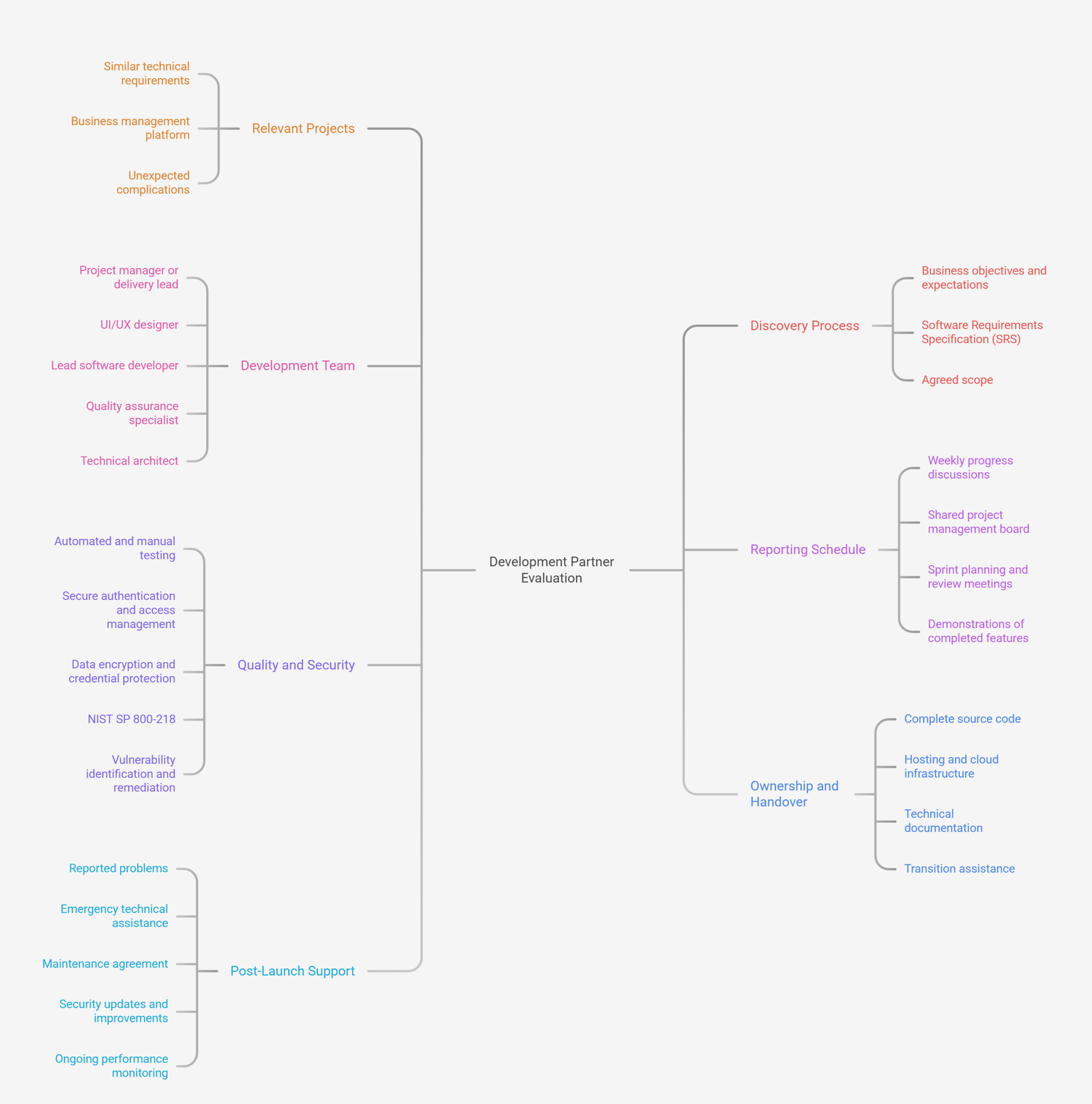
7 Essential Factors to Examine Before Hiring a Development Partner
Comparing development companies becomes easier when you establish a consistent evaluation framework.
Instead of relying on impressions, assess every shortlisted company against the following seven considerations. Give each category a score between 1 and 5, and request supporting evidence wherever possible.
1. Examine Relevant Projects Rather Than Impressive Portfolios
A development company’s portfolio can reveal plenty about its design capabilities, but appearance alone tells very little about the technical quality of its work.
Ask for two or three projects that share similar technical requirements with your proposed application.
For example, if you are developing a business management platform, look for previous experience involving:
- User registration and role-based permissions.
- Payment gateways and financial transactions.
- Third-party software integrations.
- Large databases and reporting functionality.
- Complex administrative dashboards.
- Applications designed for increasing user activity.
Go beyond simply asking whether the company has completed similar projects. Ask how the development team handled unexpected complications, what went wrong during implementation, and how those issues were resolved. An honest discussion about a difficult project can reveal more about a company’s capabilities than ten carefully selected portfolio screenshots.
2. Look for a Proper Discovery and Requirements-Gathering Process
A reliable development company should not rush into providing a fixed quotation before understanding what you actually need. The discovery stage gives both parties an opportunity to examine business objectives, customer expectations, essential features, integrations, technical limitations, and anticipated growth. One of the most valuable deliverables from this process is a Software Requirements Specification (SRS).
An SRS document establishes:
- The application’s purpose and intended users.
- Functional requirements and essential features.
- User journeys and operational workflows.
- Required integrations and external dependencies.
- Performance and security expectations.
- Acceptance criteria for completed functionality.
This document becomes a reference throughout development. It also makes it easier to identify whether a requested change falls within the agreed scope or requires additional work. If a company offers to price an entire software product after reading a brief description without asking meaningful questions, reconsider the arrangement. A dependable team wants to understand what it is building before committing to how much it will cost.
3. Meet the People Who Will Actually Develop Your Software
During initial discussions, you will usually interact with a business development representative or sales consultant. However, these individuals may not be responsible for the technical execution of your project. Before signing an agreement, request a meeting with the people who will handle the actual work.
Ideally, you should meet:
- The project manager or delivery lead.
- The UI/UX designer.
- The lead software developer.
- The quality assurance specialist, where applicable.
- The technical architect for more complex projects.
Ask about their responsibilities, professional experience, and involvement in important technical decisions. You should also understand who reviews the code, supervises junior developers, and handles technical disagreements. A company might have an impressive reputation, but the people assigned to your project will determine the quality of your experience.
4. Demand a Transparent Development and Reporting Schedule
Software development should never become a mysterious process where the client waits several weeks without seeing meaningful progress. Before development begins, establish how frequently the team will share updates, demonstrate completed functionality, and discuss outstanding issues.
A professional delivery arrangement should generally include:
- Weekly progress discussions.
- Access to a shared project management board.
- Clearly assigned development tasks.
- Sprint planning and review meetings.
- Demonstrations of completed features.
- Regular testing and feedback opportunities.
You should be able to see what has been completed, what remains outstanding, and whether the project is following its agreed schedule. Regular communication also allows you to provide feedback before a feature becomes deeply embedded in the application. If you constantly need to ask the development company for updates, its reporting process probably needs attention.
5. Make Software Quality and Security Part of the Development Process
Security should never be treated as a final checklist item immediately before launch. A professional development team considers potential vulnerabilities throughout the software lifecycle, from architectural planning to deployment and ongoing maintenance.
Ask prospective partners how they approach:
- Automated and manual software testing.
- Code reviews and development standards.
- Secure authentication and access management.
- Data encryption and credential protection.
- Database backups and recovery procedures.
- Third-party dependencies and library updates.
- Vulnerability identification and remediation.
It is also worth asking how their practices align with NIST SP 800-218, which outlines the Secure Software Development Framework. The important thing is not whether the company can mention recognised security standards. What matters is whether it can demonstrate how those practices are incorporated into actual development work. Request examples rather than accepting general assurances.
6. Establish Software Ownership and Handover Conditions Before Signing
Intellectual property ownership is one of the most important contractual matters in custom software development. The agreement should clearly explain who owns the commissioned source code, project documentation, and other deliverables. It should also establish how the client receives access to essential infrastructure and administrative accounts.
Before signing, clarify the following:
- Will the client receive the complete source code?
- Who controls the hosting and cloud infrastructure?
- Are repository and deployment credentials accessible?
- Will technical documentation be provided?
- Are third-party licences and dependencies documented?
- What happens if the business decides to change development companies?
A proper handover arrangement should include the necessary documentation, source code, access credentials, and reasonable transition assistance. Without these provisions, changing development partners can become unnecessarily difficult. Your software should remain an asset of your business, not a source of permanent dependence on its original developer.
7. Understand What Happens After the Software Goes Live
Launching an application is an important milestone, but it does not mark the end of development responsibilities. Real users may uncover issues that never appeared during testing. External services may change, operating systems receive updates, and business requirements evolve. Before committing to a company, discuss its post-launch support arrangements.
Important questions include:
- How quickly does the team respond to reported problems?
- Is emergency technical assistance available?
- What is included in the maintenance agreement?
- Are bug fixes covered separately from new features?
- How are security updates and software improvements handled?
- Does the company provide ongoing performance monitoring?
A reliable development partner recognises that software requires continued attention.
How to Choose a Custom Software Development Partner: A Practical Process
Once you understand what makes a development company dependable, the next step is to follow a selection process that allows you to compare candidates fairly.
Do not begin by collecting quotations. Start by defining your requirements.
Step 1: Prepare a Brief Description of Your Project
Write down the problem you want the software to solve, who will use it, and what the first release must accomplish. Include your approximate budget, important deadlines, and any existing systems that need to be integrated. You do not need a lengthy technical document at this stage. A clear one-page brief is often sufficient to begin meaningful discussions.
Step 2: Shortlist Three or Four Development Companies
Look for companies with relevant technical experience, a credible portfolio, and a team capable of handling your requirements. Review their previous work, check client testimonials, and arrange discussions with the people responsible for development. Avoid filling your shortlist with companies that have similar marketing material but little evidence of actual delivery experience.
Step 3: Consider a Paid Discovery Phase
For a substantial software project, a dedicated discovery phase is often a worthwhile investment. During this stage, the development company should examine your requirements and prepare useful deliverables, such as:
- A Software Requirements Specification.
- An initial technical architecture.
- A proposed technology stack.
- A development roadmap.
- A realistic project estimate.
This gives you a clearer picture of the work before committing to the complete development agreement.
Step 4: Compare Proposals Using Identical Criteria
Evaluate every proposal against the same requirements. Look beyond the headline quotation and examine the proposed team, project scope, development methodology, security arrangements, ownership conditions, and maintenance costs. A cheaper proposal may exclude important functionality or leave substantial responsibilities to the client. The objective is to identify the most commercially sensible arrangement, not simply the lowest initial expense.
Step 5: Speak With Previous Clients
Client references can provide information that a company website or sales presentation cannot.
Where possible, contact at least two previous customers and ask:
- Did the company meet its original deadlines?
- Were additional expenses introduced during development?
- How effectively did the team communicate?
- Were technical problems resolved promptly?
- Was the handover process satisfactory?
- Would you hire the same company again?
Pay particular attention to the final question.
Step 6: Begin With a Clearly Defined First Release
Rather than committing to an extensive long-term arrangement immediately, consider starting with a defined development milestone. The agreement should explain what will be delivered, how completion will be assessed, and what happens if either party decides not to continue. Include appropriate termination and handover provisions. This gives both sides an opportunity to establish a working relationship without creating unnecessary long-term obligations.
A paid discovery phase may initially appear to be another project expense. In reality, it can be among the most valuable investments you make because identifying a flawed requirement before development begins is considerably less expensive than correcting it after launch.
Technology, Integrations, Security, and Scalability: What Should You Discuss?
You do not need to select the programming language, database, or cloud platform yourself. Those decisions should be guided by the development team’s technical expertise. However, you should understand why a particular approach is appropriate for your business.
Technology Selection
Ask the development company why it recommends a particular technology stack and what considerations influenced that decision.
A sensible recommendation should account for:
- The application’s functional requirements.
- Long-term maintenance requirements.
- Hosting and infrastructure expenditure.
- Availability of experienced developers.
- Performance and security considerations.
- Future expansion and integration needs.
Be cautious of companies that recommend the same technologies for every project without considering the client’s circumstances.
A fashionable framework is not necessarily the right foundation for a business application.
The best technology is the one that supports your requirements today without creating unnecessary restrictions tomorrow.
Third-Party Integrations
Most modern business applications depend on external platforms to perform certain operations. These might include payment gateways, email services, customer relationship management systems, accounting platforms, identity providers, mapping services, and AI-powered tools. Prepare a list of every external service your application needs to communicate with.
Then ask the development team:
- How will each integration be implemented?
- Who will maintain it?
- What happens if the external provider changes its API?
- How are failed transactions or requests handled?
- Will the application continue functioning if an external service becomes temporarily unavailable?
Integration planning is particularly important because seemingly minor connections can introduce substantial development and maintenance challenges.
Software Security
A secure application requires more than a strong password system. The development company should have a defined approach to identifying threats, controlling access, protecting sensitive information, reviewing code, and addressing vulnerabilities. Ask whether the team conducts security assessments during development and how it handles newly discovered risks. NIST SP 800-218 provides a useful framework for evaluating these practices because it considers security throughout the development lifecycle rather than treating it as a final inspection.
If a company discusses security only when presenting its sales proposal, ask for a more detailed explanation.

Scalability and Future Expansion
Scalability is not simply about whether an application can accommodate a million users from its first day. It is about whether the underlying architecture can accommodate additional customers, features, integrations, and operational demands without requiring an expensive redevelopment exercise. For example, a business might initially need a basic customer portal. A year later, it may want to introduce mobile applications, advanced analytics, automated workflows, and additional user permissions. The original architecture should make these improvements manageable. Ask the development company how it plans to accommodate growth and which architectural decisions could affect future expansion. Good engineering involves preparing for realistic business growth without building unnecessary complexity into the first release.
Where the Right Development Partner Makes a Difference
Different businesses approach custom software development with different priorities. A startup developing its first product has very different requirements from an established company replacing an ageing management system. Nevertheless, the selection of a development partner remains equally important. Here are four situations where choosing the right team can significantly influence the outcome.
SaaS Startups Developing an MVP
For an early-stage SaaS business, the primary objective is to validate the commercial idea without exhausting its available resources. A capable development partner understands the importance of prioritization. Rather than building every feature proposed by the founder, the team identifies the essential functionality needed to test the product with real users. The first release should be focused, practical, and capable of providing useful feedback. An agency that constantly encourages unnecessary features or an oversized initial build may not be the right choice for an MVP.
Fintech Companies Developing Financial Applications
Financial technology products require careful attention to security, user verification, transaction management, and data protection. Features such as identity verification, payment processing, audit trails, and financial reporting must be considered during the earliest planning stages. The development company should understand the technical and regulatory considerations relevant to the product. More importantly, it should be able to explain how financial information and customer data will remain protected throughout the application.
Businesses Replacing Legacy Software
Replacing an older business system can be considerably more complicated than developing a completely new application. Existing databases may contain years of operational information, employees may depend on familiar workflows, and certain processes may rely on undocumented workarounds. The right development partner understands that successful modernisation involves more than writing new code.A phased migration strategy, proper data validation, staff training, and temporary parallel operation can help businesses transition without disrupting essential activities.
Established Companies Introducing Mobile Applications
A business that already operates through a website, management platform, or internal system may want to introduce a dedicated mobile application. However, the application must complement existing operations rather than create another disconnected platform. The development team should understand how employees, customers, and management interact with the current system before designing the new experience.
Spending time with actual users can reveal practical requirements that would otherwise remain unnoticed during initial planning. Across all these scenarios, one principle remains consistent: a development partner that challenges an unrealistic assumption early can save the business from considerably larger complications later.
Why Choose DevVibe for Custom Software Development?
Choosing a software development company requires confidence in its technical capabilities, but the working relationship matters just as much. DevVibe approaches custom software development with an emphasis on understanding business requirements, establishing a clear development direction, and creating solutions that can evolve alongside changing operational needs.
Rather than treating software development as a collection of isolated programming tasks, the objective is to deliver a product that addresses an identifiable business requirement. DevVibe’s Software Development Services cover custom software solutions, SaaS platforms, MVP development, system modernization, and third-party integrations.
For businesses looking to develop mobile applications or incorporate artificial intelligence into their products, Application Development Services provide additional development capabilities. Companies that need guidance before committing to a major technical project can also explore IT Consultation Services. These services help businesses assess their technical direction, consider architectural requirements, and establish a practical development roadmap.
The cost and delivery schedule of custom software depend on several project-specific considerations. Requirements complexity, user roles, external integrations, security expectations, and the intended scope of the first release all influence the final estimate. For this reason, a meaningful quotation should explain the factors behind the proposed investment instead of presenting a single figure without context. If you are considering a new application, modernizing an existing platform, or developing software around a particular business model, starting with a proper requirements discussion is a sensible first step.

FAQs
Q1. How do I choose the right custom software development company?
A. Begin by defining your business requirements and identifying the primary purpose of the proposed software. Shortlist three or four development companies with relevant project experience and assess their technical capabilities, discovery process, assigned team, communication arrangements, security practices, and post-launch support.
Q2. What questions should I ask a software development partner before signing an agreement?
A. Before entering into a development agreement, ask who will manage your project, which developers will handle the implementation, and how progress will be reported. You should also discuss the discovery process, estimated delivery schedule, pricing structure, change requests, software ownership, security procedures, and maintenance arrangements.
Q3. How much does custom software development cost?
A. The price of custom software development varies considerably according to the size and complexity of the project. An application with a few basic features will generally require a different investment from a sophisticated enterprise platform involving multiple user roles, financial transactions, external integrations, and advanced security requirements.
Q4. Should I hire a freelancer, an agency, or build an in-house development team?
A. The right arrangement depends on the nature and duration of your software requirements. A freelancer can be suitable for a small assignment with clearly defined deliverables. However, complex projects often require expertise across several disciplines, including software engineering, interface design, quality assurance, and project management. A development agency or dedicated team provides access to a broader range of capabilities without requiring you to recruit an entire internal department.
Q5. What is an SRS, and do I need one before hiring a software developer?
A. SRS stands for Software Requirements Specification. It is a formal document that describes what an application needs to accomplish, who will use it, how its features should operate, and which technical requirements must be satisfied. SRS typically covers functional requirements, user roles, integrations, performance expectations, and acceptance criteria.
Conclusion
Selecting a custom software development partner is a decision that deserves considerably more attention than comparing quotations and reviewing attractive portfolios. The cheapest proposal can become the most expensive mistake when important requirements are overlooked, technical decisions are rushed, or the development team fails to document its work. A dependable partner takes time to understand your business, identifies potential complications, establishes realistic expectations, and maintains transparency throughout the development process.
Look for a company that can demonstrate relevant experience, introduce you to its actual development team, explain its security practices, and provide clear arrangements for software ownership and ongoing support. Most importantly, pay attention to how the company responds when you present a challenging requirement. A team that questions an unrealistic assumption is often far more valuable than one that agrees with every suggestion simply to secure the contract. If you are currently comparing development companies, use the evaluation criteria discussed in this guide before making your final decision.
Talk to DevVibe About Custom Software Development
Start with a conversation about your business requirements, explore the available technical approaches, and obtain a development estimate based on the actual scope of your project. Build software that serves your business today while leaving room for what comes next.