

 Pakistan (Head Office):
 Australia:
 USA (Virtual Office):
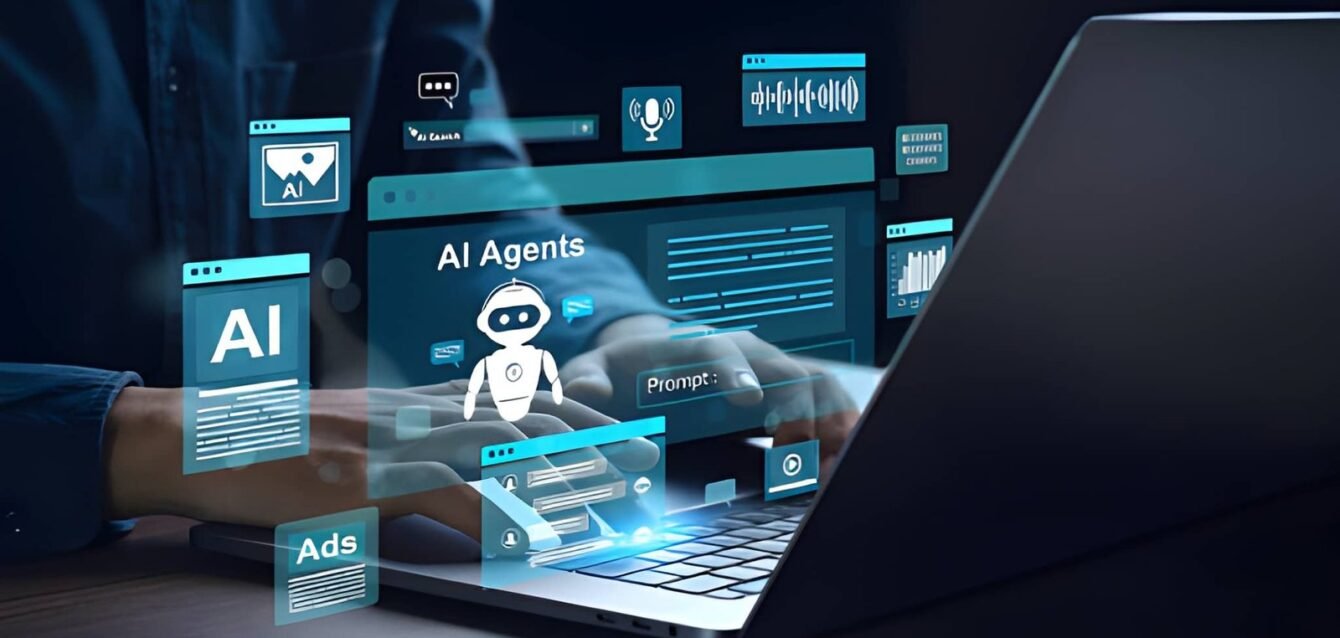
Artificial intelligence is changing how businesses manage customer support, sales, internal operations, and decision-making. But while many companies are experimenting with AI, the real challenge is turning that technology into something that solves practical business problems. You might want to automate repetitive administrative tasks, qualify leads around the clock, analyze large amounts of business data, or connect multiple software systems without constant human intervention. The right technology partner can help you achieve those goals, but choosing the wrong one can leave you with an expensive prototype that never delivers meaningful results.
That is why finding the right AI agent development company requires more than comparing websites, technical promises, or attractive demonstrations. You need a team that understands your business processes, identifies the right use cases, builds secure integrations, and measures whether the finished solution actually improves performance. In this guide, we will explore the key factors to consider, the services to expect, the questions to ask potential providers, and the mistakes to avoid before signing a development agreement.
What Is an AI Agent Development Company?
An AI agent development company designs, builds, integrates, and maintains software agents that can work toward defined objectives with varying degrees of autonomy. Unlike a conventional application that follows a fixed sequence of instructions, an AI agent can interpret information, decide which supported action to take, use connected tools, and evaluate the result. Depending on its design, it might retrieve information from a company database, update a customer relationship management system, prepare a report, or route a complex request to a human employee.
For example, imagine a sales team receiving hundreds of inquiries every week. A properly designed AI agent could classify incoming leads, review information submitted through a website, identify promising opportunities, update the CRM, and recommend the next step. Employees would still supervise important decisions, but they would spend less time handling routine administrative work. This is where experienced AI agent development companies can create business value: they combine AI models with software engineering, business rules, integrations, testing, and operational controls.
However, an AI agent is not automatically the right answer to every business problem. A straightforward workflow with predictable inputs and outputs might be better handled by traditional automation. A knowledgeable development partner should evaluate your requirements honestly rather than recommend an AI solution simply because it sounds innovative.
AI Agents vs. Traditional Chatbots
Traditional chatbots typically respond to user messages, answer predefined questions, or retrieve information. AI agents can go further by executing multistep workflows through authorized tools and integrations. The distinction is not absolute because modern chatbots can also use tools, while some agents operate with very limited autonomy. What matters is the system’s actual capabilities, permissions, and reliability rather than the label attached to it.
| Feature | Traditional chatbot | AI agent |
|---|---|---|
| Primary purpose | Answer questions and guide conversations | Complete tasks toward a defined goal |
| Workflow | Often conversational and relatively limited | Can involve multiple steps and tools |
| System integrations | Frequently focused on retrieving information | Can read or update connected systems when authorized |
| Decision-making | Usually limited to its configured scope | Can select actions within defined boundaries |
| Human oversight | Useful for difficult or sensitive queries | Important for consequential actions and exceptions |
| Typical applications | FAQs and basic customer support | Lead qualification, workflow automation, research, and operational assistance |
When evaluating an AI agent development company, ask the team to demonstrate the actions its proposed solution will perform, not just the answers it can generate. A convincing conversation is only one part of the picture. The more important question is whether the system can complete your intended workflow accurately, safely, and consistently.
Why Your Business Needs AI Agent Development Services
Businesses often lose time because employees repeatedly perform tasks that require several small steps. A customer support representative might search documentation, check an order in another system, draft a response, and update a ticket. A sales employee might review incoming leads, research prospects, prepare personalized outreach, and record every interaction. These activities may seem manageable individually, but they consume substantial time when repeated hundreds of times.
Well-designed AI agent development services can help streamline these processes by combining reasoning capabilities, business data, APIs, and workflow automation. Instead of requiring employees to move information manually between systems, an agent can perform approved steps and flag cases that need human attention. This can improve response times, reduce repetitive work, and help teams focus on responsibilities that require judgment, creativity, and relationship-building.
The benefits depend on the workflow, the quality of the underlying data, and the reliability of the implementation. An agent that frequently makes incorrect updates or requires constant intervention might create more work than it saves. Before investing, define a measurable business outcome, such as reducing average ticket-handling time, improving lead response speed, or shortening the time required to prepare reports. That outcome should guide the entire project.
Common Business Use Cases for AI Agents
AI agents can support different departments, but each application needs a clear purpose, suitable data access, and appropriate controls. The most practical starting point is usually a repetitive, well-defined workflow where mistakes can be detected and corrected before they cause significant damage.
| Department | Potential AI agent application | Business benefit |
|---|---|---|
| Customer support | Classify tickets, retrieve answers, and prepare responses | Faster handling of routine inquiries |
| Sales and marketing | Qualify leads and update CRM records | Less administrative work for sales teams |
| Finance | Collect invoice information and flag discrepancies | More efficient document processing |
| Human resources | Answer policy questions and assist with onboarding | Easier access to internal information |
| E-commerce | Track order inquiries and support product discovery | Improved customer experience |
| Operations | Monitor workflows and flag delays or exceptions | Better visibility into daily processes |
| Research and analytics | Gather authorized data and prepare summaries | Faster access to useful insights |
These examples are starting points, not guaranteed outcomes. A finance agent that prepares a draft reconciliation is different from one that independently transfers funds. Similarly, an HR assistant that retrieves approved policies is different from one that makes employment decisions. The development partner should define exactly what the agent can do, what requires approval, and what must remain under human control.
8 Factors to Consider When Choosing an AI Agent Development Company
Choosing a development partner becomes easier when you evaluate every candidate against the same criteria. Rather than relying on marketing claims, request evidence that demonstrates how each team handles real business requirements, technical complexity, risk, and long-term operations.
1. Industry Experience and Technical Expertise
Start by assessing whether the company understands both AI engineering and your business environment. A provider might have experience building conversational assistants but limited experience integrating enterprise software, processing structured business data, or operating systems that perform real actions. Those differences matter because production AI agents require more than a well-written prompt. They need suitable model selection, application logic, integration architecture, testing, permissions, and recovery mechanisms.
Ask prospective providers to explain projects that resemble your intended use case. They should be able to discuss the original problem, the system architecture, the integrations involved, the challenges encountered, and the results measured after deployment. If client confidentiality prevents sharing source code or private records, the company can still provide anonymized architecture diagrams, representative test results, or a reference with permission.
Technical expertise should also extend beyond one framework or AI model. Depending on your requirements, the team might need experience with large language models, retrieval-augmented generation (RAG), vector databases, API development, cloud infrastructure, workflow orchestration, and observability tools. The right technologies depend on the project rather than a fashionable technology stack.
A reliable AI agent development company will explain why its proposed architecture fits your needs and where simpler alternatives might be more effective. It should also be comfortable discussing limitations instead of promising perfect accuracy or complete autonomy.
2. Customization and Scalability
Every business has its own workflows, approval structures, data sources, and customer expectations. A generic AI agent might work well for a basic demonstration but struggle when it encounters company-specific terminology, unusual customer requests, legacy systems, or exceptions to normal business procedures. That is why customization should be evaluated in terms of how well the proposed solution fits your actual operations.
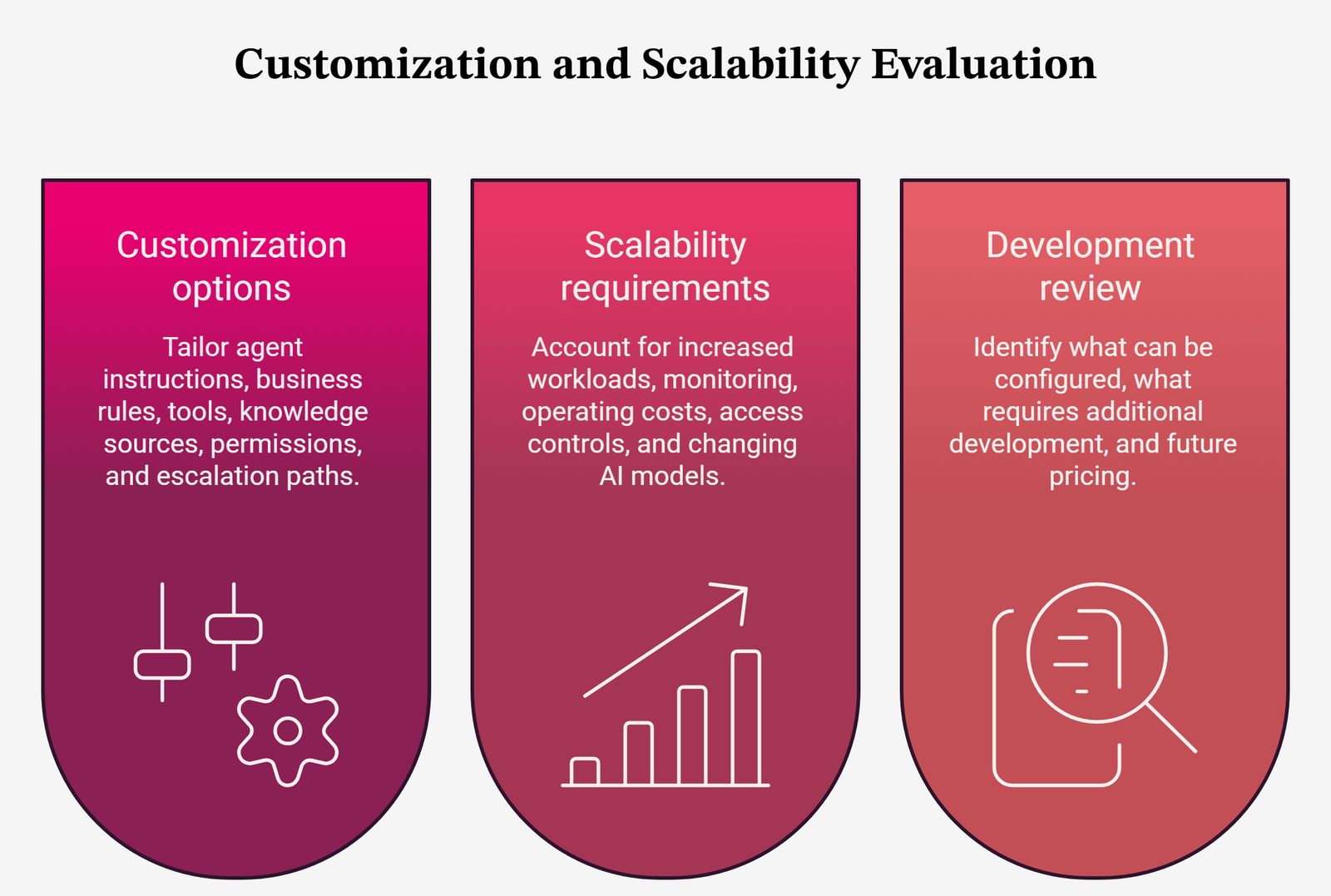
Ask whether the provider can tailor the agent’s instructions, business rules, tools, knowledge sources, permissions, and escalation paths. For example, an agent used by an online retailer may need to check inventory, verify an order’s status, and draft a response using approved return policies. The same architecture might not suit a healthcare organization or a financial services provider, where data sensitivity and decision-making risks can be substantially different.
Scalability is equally important. Your system may begin with one department and later expand to multiple teams, languages, regions, or business applications. A scalable design should account for increased workloads, monitoring, operating costs, access controls, and the possibility of changing AI models. Adding more users should not require rebuilding the entire solution.
When reviewing custom AI agent development services, ask what can be configured, what requires additional development, and how future changes will be priced. A clear answer helps you avoid paying for an inflexible system that becomes difficult to maintain as your business grows.
3. Integration With Existing Business Systems
An AI agent becomes considerably more useful when it can work with the systems your employees already use. These may include CRMs, ERP platforms, help desks, inventory management software, databases, accounting tools, communication platforms, and internal knowledge bases. Without suitable integrations, the agent might produce suggestions but still leave employees responsible for copying information and completing the actual work.
A capable development team should review your current software environment before recommending an integration strategy. It should identify available APIs, authentication requirements, data formats, system limitations, and any dependencies on older applications. It should also explain how information will move between systems and how the agent will respond when a connected service becomes unavailable.
Consider a business that wants an agent to qualify leads and create CRM records. The agent should validate required fields, check for duplicate records, respect user permissions, and report failed updates instead of claiming that a task succeeded. If the CRM is temporarily unavailable, the system needs a controlled recovery process rather than silently losing the information.
Ask potential vendors to explain their approach to API security, retries, error handling, data validation, and integration testing. A demonstration that works only with sample data is not enough. Your AI agent development company should show how the proposed workflow will operate within your real software environment, including its limitations and exception cases.
4. Security, Privacy, and Compliance
Security should be a central selection criterion, especially when agents can access confidential documents, customer information, financial records, or operational systems. Unlike a system that only generates text, an agent with tool access may be able to create records, send messages, or change business data. Poorly designed permissions can turn a small AI mistake into a serious operational problem.
Ask how the provider handles authentication, role-based access control, encryption, secrets management, data retention, audit logs, and incident response. You should also understand whether prompts and business data are sent to third-party AI providers, what their retention terms are, and whether your organization can control where sensitive information is processed. Requirements will vary according to your industry, customer locations, and contractual obligations.
Another important risk is prompt injection, where malicious or misleading content attempts to manipulate an AI system into ignoring its intended instructions. An agent that reads emails, webpages, uploaded documents, or customer messages may encounter untrusted instructions. Security measures should therefore include restricted tool permissions, validation of actions, separation of trusted instructions from untrusted content, and human approval for high-impact operations.
The National Institute of Standards and Technology provides an AI Risk Management Framework and a generative AI profile that organizations can use to structure risk management and evaluation. These resources offer a useful starting point for discussing governance with a vendor.
A trustworthy provider should be able to explain these safeguards in practical terms, not merely claim that its solutions are secure. Ask for documented security practices and determine which responsibilities belong to your organization and which belong to the vendor.
5. Testing, Monitoring, and Reliability
AI systems can produce different outputs for similar inputs, and an agent may fail because of incorrect reasoning, missing information, unavailable tools, unexpected data, or model changes. For that reason, testing must cover the entire workflow rather than just the quality of individual responses. Your development partner should demonstrate how it will measure success and identify failures before the system reaches production.
Start by asking for a defined set of test scenarios based on real business cases. These should include routine tasks, incomplete information, unusual requests, incorrect data, unauthorized actions, and situations where the agent should stop and ask for human help. The team should establish acceptance criteria before development begins so that both sides know what constitutes a successful delivery.
After launch, monitoring should track task completion, error rates, escalation frequency, response times, cost per task, and other metrics relevant to the business goal. Logs and traces should help authorized staff understand which tools were called, what went wrong, and where an intervention was required, while avoiding unnecessary exposure of sensitive data.
A strong AI agent development company should also provide a plan for regression testing when prompts, models, APIs, or business rules change. The goal is not to eliminate every possible error, which is unrealistic, but to detect problems early, limit their impact, and improve reliability over time.
6. Transparent Pricing and Return on Investment
The lowest development quote is not necessarily the most economical choice. One vendor may offer a low initial price but exclude integration work, deployment, monitoring, documentation, or ongoing maintenance. Another may charge more upfront while delivering a more complete solution with clearer ownership and lower operational risk. Comparing these proposals requires looking beyond the initial invoice.
Ask for an itemized estimate that separates discovery, design, development, integrations, testing, deployment, and post-launch support. Clarify which expenses are recurring, including model usage, cloud hosting, third-party services, storage, monitoring, and maintenance. Pricing may depend on workflow complexity, the number of integrations, data readiness, security requirements, and expected usage, so avoid relying on a universal cost estimate before the scope is understood.
You should also calculate the potential return on investment. Estimate the time currently spent on the workflow, the proportion of tasks that can realistically be automated, the amount of human review required, and the cost of mistakes. Compare these figures with the total cost of building and operating the solution.
For instance, an agent that reduces administrative work but requires extensive manual correction may not generate the savings you expected. A smaller solution that handles a narrower workflow consistently could deliver better value. A credible provider will help you establish a baseline and agree on measurable targets rather than guaranteeing financial results without evidence.
7. Communication and Project Management
AI projects involve business stakeholders, developers, data specialists, security teams, and sometimes third-party software providers. If communication breaks down, requirements can change without proper approval, integration problems may appear late, and stakeholders may disagree about whether the final product meets expectations. A well-organized development process helps prevent these problems.
During the initial discussions, notice whether the company asks detailed questions about your workflow, users, data, constraints, and success criteria. A team that immediately proposes a complex architecture without understanding the business problem may be focusing on technology rather than outcomes. You should receive a clear project plan describing milestones, responsibilities, dependencies, risks, and deliverables.
Ask how often you will review progress, who will serve as your main contact, and how the team will manage scope changes. Regular demonstrations using realistic workflows can reveal misunderstandings before they become expensive to fix. You should also know how decisions will be documented and who approves changes to functionality, timelines, and costs.
If you work with a distributed team, establish expectations for response times, meeting schedules, documentation, and time-zone overlap. The objective is to create a working relationship in which problems are raised early and decisions are made with enough information. Technical skill matters, but consistent communication is what helps translate that skill into a successful project.
8. Post-Launch Support and Maintenance
Deployment is not the finish line. AI models evolve, third-party APIs change, business processes are updated, and new edge cases emerge as more people use the system. Without an ongoing maintenance plan, an agent that performs well during the initial rollout may gradually become less reliable or more expensive to operate.
Before signing a contract, ask what happens after launch. Does the vendor provide monitoring, incident response, bug fixes, performance reviews, model updates, security patches, and user training? Is support included for a defined period, or is it billed separately? You should also clarify response-time commitments, escalation procedures, service availability expectations, and the cost of changes outside the original scope.
Ownership and knowledge transfer deserve equal attention. Your team should receive appropriate technical documentation, configuration details, deployment instructions, test cases, and access to the systems needed to operate the solution. The agreement should specify who owns the custom code, prompts, workflows, and project-specific materials, subject to any third-party licensing terms.
A dependable AI agent development company treats support as part of the delivery strategy instead of an afterthought. Ask for a written handover plan and confirm that your business can maintain, extend, or migrate the system if the partnership eventually ends.
What AI Agent Development Services Should Include
Service offerings vary, so examine the actual deliverables rather than relying on a service page or proposal heading. Comprehensive AI agent development services often begin with business discovery and workflow assessment, followed by solution architecture, data preparation, agent development, system integration, testing, deployment, and ongoing optimization. Each stage should have a clear purpose and an agreed output.
Discovery is particularly valuable because it helps establish whether an AI agent is appropriate in the first place. The provider should map the existing workflow, identify repetitive tasks, review the data and software involved, and determine where human judgment remains necessary. This stage should also define the risks, success metrics, and smallest useful version of the solution.
The technical work may involve selecting AI models, connecting knowledge sources, developing tools, implementing business logic, setting permissions, and creating evaluation tests. Depending on the use case, the agent may need retrieval-augmented generation, structured outputs, workflow orchestration, or multiple cooperating agents. More components do not automatically mean a better solution; complexity should be justified by a clear requirement.
A complete service should also cover deployment and operational readiness. This includes production configuration, access management, logging, monitoring, staff training, documentation, and a plan for handling failures. If the vendor offers only a prototype, make sure you understand the additional work and costs required to turn it into a reliable production system.
What Is the Difference Between Standard and Custom AI Agent Development?
Standardized solutions can be effective when your needs closely match a proven workflow. They may be faster to configure and less expensive to launch, especially when the required integrations and controls are already supported. However, they can become restrictive when your organization relies on unusual business rules, specialized data, or complex cross-platform processes.
Custom AI agent development services are designed around your specific workflows, integrations, permissions, and operational requirements. They can offer greater flexibility, but they also require careful scoping, testing, and ongoing maintenance. Custom development is not automatically superior; the best choice depends on how well an existing product meets your needs and how much differentiation your workflow requires.
| Consideration | Standard solution | Custom solution |
|---|---|---|
| Initial implementation | Often faster | Usually requires more discovery and development |
| Custom workflows | Limited by available configuration | Can be tailored to specific requirements |
| Integration options | Depends on supported connectors | Can support specialized integrations when feasible |
| Initial cost | Often lower | May be higher |
| Maintenance | May be handled by the platform provider | Requires a clear internal or external support plan |
| Best fit | Common, well-supported workflows | Specialized or cross-system business processes |
An experienced provider should explain both options and help you choose based on business value, complexity, risk, and long-term ownership.
How to Compare AI Agent Development Companies
Once you have identified several potential providers, evaluate them using the same questions, evidence requirements, and scoring criteria. This makes it easier to distinguish a company with strong presentation skills from one that can actually deliver a dependable solution. Avoid making the decision solely on the strength of a demonstration or the number of technologies listed on a website.
Begin by requesting relevant case studies, a proposed technical approach, an outline of the testing process, and a breakdown of costs. Ask each vendor to explain how its solution would handle the same representative workflow, including exceptions and security requirements. If possible, use a small paid discovery engagement to assess how well the team understands your requirements before committing to a larger project.
The following scorecard can help structure your evaluation.
| Evaluation criterion | Suggested weight | What to look for |
|---|---|---|
| Relevant experience | 15% | Comparable projects and verifiable delivery evidence |
| Technical architecture | 15% | Clear reasoning behind models, tools, and integrations |
| Security and governance | 15% | Access controls, auditability, and risk management |
| Testing and monitoring | 15% | Measurable acceptance criteria and ongoing evaluation |
| Business understanding | 15% | Clear workflow analysis and realistic success metrics |
| Pricing and ROI | 10% | Itemized costs and a defensible business case |
| Support and ownership | 10% | Maintenance plan, documentation, and ownership terms |
| Communication | 5% | Clear reporting, responsibilities, and escalation paths |
| Total | 100% | Compare evidence across all shortlisted vendors |
Score each criterion consistently, for example from one to five, and convert the ratings into weighted scores. The weights are a suggested starting point, not a universal formula; organizations with strict regulatory obligations may need to give security and governance even greater importance.
Questions to Ask Before Hiring an AI Agent Development Company
Before selecting a partner, ask questions that reveal how it handles real-world delivery rather than only ideal scenarios. The following questions are useful during vendor interviews:
1.Have you delivered a comparable AI agent into production, and what measurable results did it achieve?
2.Which parts of my workflow should be automated, and which should remain under human supervision?
3.How will the agent access my systems and prevent unauthorized actions?
4.How will you evaluate accuracy, task completion, exceptions, and failure recovery?
5.What happens if an AI model, external API, or connected service becomes unavailable?
6.Which costs are included in the proposal, and which will recur after launch?
7.Who owns the custom code, configurations, documentation, and deployment environment?
8.What monitoring, maintenance, and support will you provide after deployment?
Pay attention not only to the answers but also to the evidence behind them. Strong providers can explain trade-offs, acknowledge uncertainty, and describe what they would test before making a commitment. If a vendor promises that an agent will never make mistakes, automate every process, or deliver a guaranteed return without understanding your data and workflow, treat that as a warning sign.
Looking for an AI Agent Development Company in the USA? Consider DevVibe
Choosing the right AI partner is an important step toward turning your business ideas into practical, intelligent solutions. If your company is looking for an AI agent development company in the USA, DevVibe is a technology partner worth considering for custom AI development, enterprise solutions, and software products designed around real business requirements.
DevVibe helps businesses explore AI opportunities, develop intelligent applications, improve existing software, and streamline workflows through technology. Its AI development services cover AI product development, enterprise AI solutions, proof-of-concept (PoC) and minimum viable product (MVP) development, AI consulting, and AI training and support. These capabilities can help businesses move from an initial idea to a solution that can be tested, refined, and prepared for real-world use.
How DevVibe Can Help With Your AI Development Goals
Custom AI solutions: Every business has different requirements. DevVibe can help assess your objectives and explore AI solutions tailored to your products, data, and operational workflows.
AI-powered workflow automation: Businesses can explore opportunities to streamline repetitive processes, improve information handling, and introduce AI capabilities into existing operations.
AI integration and software development: AI becomes more useful when it works with your existing applications and systems. DevVibe also provides application development services that include AI and machine learning integration, cloud-powered functionality, and ongoing software improvement.
Proof-of-concept and MVP development: If you are unsure whether an AI idea will work in practice, a proof of concept or MVP can help validate the approach before committing to a larger implementation.
Support beyond the initial build: AI products need testing, refinement, and maintenance. DevVibe’s AI development offering includes training and support capabilities to help businesses improve their solutions over time.
Relevant AI Development Experience
DevVibe’s AI development portfolio includes an AI-powered adaptive learning platform that generates quizzes from uploaded books and adapts difficulty based on student performance. The company also highlights an AI-powered real estate and insurance valuation platform, Renno-Estimator, developed in collaboration with an emerging US insurance company. These examples provide useful context when evaluating DevVibe’s experience with AI-powered products and business applications.
DevVibe also lists a US location in Dallas, Texas, alongside its Australian and Pakistani locations. For US businesses, this provides a starting point for discussing project requirements, delivery expectations, and the most appropriate engagement model.
Discuss Your AI Agent Development Project With DevVibe
Whether you want to explore an AI-powered business assistant, automate an internal workflow, integrate AI into an existing product, or validate a new AI startup idea, the first step is to define the problem and identify a measurable outcome.
Visit DevVibe’s AI development services page to explore its capabilities, or contact the DevVibe team to discuss your project requirements.
Ready to explore AI for your business? Start with a conversation about your goals, existing systems, and the workflow you want to improve. The right solution should fit your business needs, security requirements, and long-term growth plans.
Common Mistakes to Avoid When Hiring an AI Agent Development Company
One common mistake is choosing a vendor because it offers the most impressive demonstration. A polished demo usually follows a controlled path, whereas a production agent must handle missing information, unexpected requests, permission restrictions, and unavailable services. Ask to see failure handling and evaluation results alongside the successful scenarios.
Another mistake is automating a poorly defined process. If employees use inconsistent procedures or business data is unreliable, adding an AI agent may simply reproduce those problems at greater speed. Map the workflow first, resolve important data issues, and define the desired outcome before development begins.
Businesses also underestimate ongoing costs. Model usage, hosting, integration maintenance, monitoring, and human review can affect the economics of an agent after launch. Request a total cost estimate based on expected usage and agree on how spending will be monitored.
Finally, do not overlook ownership, security, and vendor dependency. A system can become difficult to maintain if only the original provider understands its architecture or controls essential infrastructure. Confirm access rights, documentation, migration options, and contractual ownership before work starts.
The best AI agent development companies do not simply sell automation. They help you decide what should be automated, how to manage the risks, how to measure performance, and how to maintain the system over time.
Conclusion
Choosing the right AI agent development company is ultimately about finding a technology partner that understands your business, not simply a team that knows how to build AI-powered applications. The best partner will study your existing workflows, identify practical opportunities for automation, integrate the right tools, and establish clear safeguards before allowing an agent to perform real tasks. It will also help you measure performance, manage costs, and improve the solution after deployment.
Start with one well-defined business problem rather than trying to automate everything at once. Compare potential providers based on relevant experience, technical expertise, integration capabilities, security practices, testing methods, transparent pricing, and post-launch support. Ask for evidence, define measurable acceptance criteria, and make sure ownership and maintenance responsibilities are documented in your contract.
Remember, a successful AI implementation is not the one with the most complicated architecture or the most impressive demonstration. It is the one that consistently solves a real business problem, operates within appropriate boundaries, and delivers measurable value. Take the time to evaluate your options carefully, and you will be in a much stronger position to choose an AI agent development company that supports your business goals today and as your organization grows.
Frequently Asked Questions
1. What does an AI agent development company do?
An AI agent development company designs, develops, tests, and deploys AI-powered systems that can complete defined tasks using business data, connected software, and authorized tools. Its services may include workflow analysis, AI model integration, custom agent development, API integrations, security controls, testing, deployment, and ongoing maintenance. The exact scope depends on your business requirements and the complexity of the proposed solution.
2. How do I choose the best AI agent development company for my business?
To select the right provider, evaluate its production experience, technical capabilities, understanding of your industry, integration expertise, security practices, and support arrangements. Ask for relevant case studies, a clear project plan, transparent pricing, and measurable acceptance criteria. A reliable partner should also explain the limitations of its proposed solution and recommend a smaller pilot when that is the most sensible way to validate your investment.
3. What are the benefits of custom AI agent development services?
Custom AI agent development services allow businesses to build solutions around their specific workflows, data sources, software integrations, and operational requirements. They can help automate repetitive tasks, improve information retrieval, streamline customer interactions, and reduce manual data entry. However, the benefits depend on implementation quality, data reliability, appropriate human oversight, and whether the solution addresses a genuine business need.
4. How much do AI agent development services cost?
The cost of AI agent development services varies according to workflow complexity, integration requirements, security needs, data readiness, deployment environment, and ongoing support. A simple internal assistant will generally require a different investment from an agent that coordinates several enterprise systems and performs consequential actions. Request an itemized proposal covering development, testing, deployment, model usage, infrastructure, and maintenance before comparing providers.
5. What should I look for when comparing AI agent development companies?
When comparing AI agent development companies, prioritize verified delivery experience, sound technical architecture, secure integrations, measurable testing, transparent costs, clear ownership terms, and dependable post-launch support. Ask each shortlisted provider to explain how its solution handles errors, protects sensitive information, and escalates decisions that require human approval. Choosing a company based on documented capabilities rather than marketing promises will help you make a more informed investment.