

 Australia:
  Pakistan:
  USA:
USA: 
Software development costs are rarely limited to the developer’s hourly rate. A project can become expensive because of repetitive coding, debugging, testing, documentation, code reviews, context switching, maintenance and delays between development stages. For Chicago startups, small businesses and established companies, these costs can make it difficult to move quickly while staying within budget.
That is where code agents are becoming increasingly relevant in 2026.
Unlike traditional autocomplete tools that simply suggest the next few lines of code, modern code agents can understand a larger development task, inspect a repository, modify multiple files, run commands, execute tests and prepare changes for human review. GitHub now supports third-party coding agents including Anthropic Claude and OpenAI Codex, while the broader market has expanded rapidly.
The opportunity for Chicago businesses is not simply to replace developers with AI. A more practical approach is to use code agents as force multipliers that allow experienced developers to complete routine work faster while spending more time on architecture, product decisions, security and customer requirements.
A 2026 NBER working paper examining more than 500,000 GitHub developers found that different generations of AI coding tools increased coding activity substantially, although the gains became smaller when measured at the level of completed projects and releases.
That distinction matters.
The goal should not be more AI-generated code. The goal should be more valuable software delivered with less wasted engineering time.
What Are Code Agents?
Code agents are AI-powered software development systems that can perform multi-step programming tasks with a degree of autonomy. Instead of asking an AI assistant for a code snippet and manually implementing it, a developer can give an agent a higher-level task such as creating an API endpoint, fixing a bug, adding tests or refactoring a module.
The agent can then reason through the task, inspect relevant files, make changes, execute development commands and evaluate the results.
Depending on the platform and permissions, an autonomous coding agent may be able to:
- Read and understand a software repository
- Search through project files
- Create or modify multiple files
- Write implementation code
- Generate tests
- Run tests and debugging commands
- Identify and fix certain errors
- Create branches or pull requests
- Respond to review feedback
- Work asynchronously on assigned tasks
This makes code agents fundamentally different from simple AI autocomplete.
A traditional coding assistant is similar to having someone finish your sentence. An agent is closer to giving a junior engineering teammate a clearly defined ticket and asking them to investigate, implement and prepare the work for review.
The difference is important for businesses because engineering costs often come from everything surrounding the actual writing of code.
How Code Agents Differ From Traditional AI Coding Assistants
Traditional AI coding tools remain useful. Autocomplete can help developers write functions faster, generate boilerplate and understand unfamiliar APIs. However, code agents operate at a broader task level.
| Capability | Traditional AI Assistant | Code Agent |
|---|---|---|
| Code completion | Yes | Yes |
| Explain code | Yes | Yes |
| Modify multiple files | Limited | Yes |
| Run terminal commands | Usually limited | Often supported |
| Run tests | Limited | Yes |
| Debug multi-step problems | Limited | Stronger |
| Work from an issue/task | Limited | Yes |
| Create pull requests | Usually no | Often yes |
| Autonomous workflow | Low | Higher |
GitHub’s current documentation describes coding agents as systems that can be assigned issues or prompts, work asynchronously and create pull requests for review.
For a Chicago software company, that means a development ticket can potentially move from requirement → implementation → testing → pull request with considerably less manual coordination.
Why Code Agents Matter for Chicago Businesses in 2026
Chicago has a diverse technology and business ecosystem spanning financial services, healthcare, logistics, manufacturing, retail, professional services and startups. Many organizations need custom software but cannot afford unlimited engineering capacity.
This creates a familiar business problem: the product roadmap keeps growing while the development team’s available hours remain limited. Code agents can help address that capacity problem.
The technology is also becoming mainstream rather than experimental. JetBrains reported in 2026 that 90% of professional developers surveyed were using AI coding agents at work at least weekly, with 68% using them daily. Its survey also reported particularly high adoption of Claude Code among US developers.
That does not mean every company should immediately automate its entire development workflow. It means businesses should understand where agents can produce measurable value.
The Rising Demand for Faster Software Delivery
US businesses increasingly compete through software.A retailer may need a better ecommerce experience. A logistics company may need route optimization. A healthcare organization may need better internal applications. A financial company may require new integrations and dashboards.
In each case, development speed affects how quickly the business can test ideas and respond to customers. Code agents can shorten certain parts of this cycle by reducing repetitive engineering work.
For example, instead of having a developer manually create similar CRUD endpoints, validation logic and basic tests, an agent can handle much of the repetitive implementation while the developer focuses on business rules and architecture.

Where Code Agents Can Reduce Development Costs
The biggest opportunity is not necessarily reducing headcount. Instead, businesses can reduce the amount of expensive developer time spent on low-value work.
Potential savings areas include:
- Boilerplate code
- Test generation
- Documentation
- Code refactoring
- Bug investigation
- Migration scripts
- Internal tools
- API integration
- Data transformation
- Basic UI components
- Dependency updates
- Repetitive maintenance
A 2026 Black Duck/UserEvidence survey of 831 software engineering and DevOps professionals found that 92% of surveyed teams reported improved productivity and release velocity from AI coding assistants, while respondents reported an average of eight hours saved per developer per week. At the same time, 90% reported workflow issues involving AI-generated code, including manual review, security testing and rework. That second statistic is just as important as the first. Code agents can reduce development effort, but poorly governed AI can also create new work.
How Code Agents Actually Work
A modern code agent typically combines an AI model with access to development tools.The model provides reasoning and code generation. The surrounding agent framework provides capabilities such as file access, terminal commands, testing, repository navigation and version control.
Think of the AI model as the brain and the development environment as the hands. Without tools, the model can suggest what should happen. With tools, the agent can actually investigate the repository and perform parts of the task.
From Business Requirement to Pull Request
A typical agent workflow might look like this:
- A developer creates a GitHub issue describing a bug.
- The code agent reads the issue.
- It examines the relevant project files.
- It identifies the likely cause.
- It modifies the required files.
- It runs the relevant tests.
- It fixes failures where appropriate.
- It prepares a branch or pull request.
- A human developer reviews the changes.
- Approved changes move through the normal CI/CD process.
GitHub’s current agent ecosystem supports this type of asynchronous workflow, including third-party agents such as Claude and Codex. For a business, the financial advantage comes from compressing the time required for steps that previously demanded significant developer attention.
Human Review Still Matters
The word autonomous can be misleading. An autonomous coding agent may independently execute multiple technical steps, but that does not mean the output should automatically enter production.
Software contains business logic, security controls, customer data and operational dependencies. An agent can misunderstand requirements or introduce subtle problems that are not obvious from a successful test run.
The strongest model for most businesses is therefore:
AI execution + automated testing + human review + controlled deployment.
This keeps developers responsible for important technical decisions while allowing code agents to handle more routine execution.
Best Coding AI Agents and Tools in 2026
The market has expanded considerably, so businesses searching for the best coding AI agents should avoid treating every tool as identical. Different agents are optimized for different environments, workflows and levels of autonomy.
GitHub Copilot, Claude Code and OpenAI Codex
GitHub currently supports Claude and Codex as third-party coding agents alongside Copilot’s own agent capabilities. GitHub says these agents can work asynchronously on development tasks and create pull requests for human review. For organizations already using GitHub, this integration can reduce workflow friction because the agent operates within an existing repository and pull-request process.
For businesses researching the best AI agents for coding, consider:
| Tool/Approach | Useful For | Business Consideration |
|---|---|---|
| GitHub Copilot | Integrated developer workflows | Strong GitHub ecosystem |
| Claude Code | Agentic coding workflows | Strong repository-level interaction |
| OpenAI Codex | Autonomous coding tasks | Useful for multi-step development |
| Open-source agents | Customization and control | Greater setup and governance requirements |
GitHub also announced broader availability of Claude and Codex for Copilot Business and Pro customers in February 2026. The best coding AI 2026 solution for one company may not be the best for another. The right choice depends on repository size, security requirements, preferred IDE, cloud infrastructure, team experience and the types of tasks being delegated.
Open Source Coding Agents
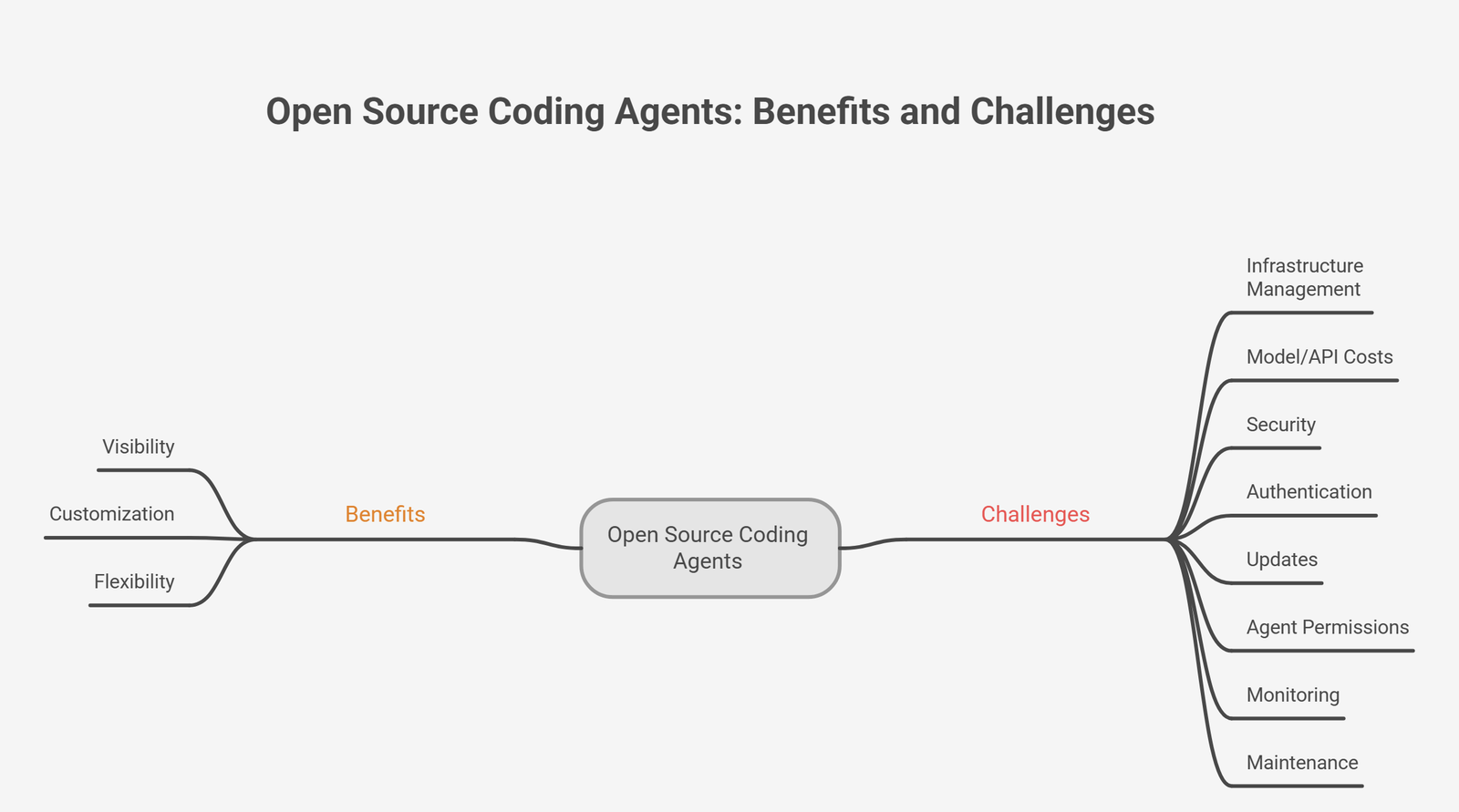
Businesses interested in control and customization may also investigate an open source code agent or open source coding agents. Open-source approaches can provide more visibility into how the system operates and can sometimes support customized models, workflows or infrastructure.
JetBrains reported that OpenCode, an open-source coding agent, had reached 7% adoption in its 2026 research. However, open source does not automatically mean lower total cost.
Organizations may need to manage:
- Infrastructure
- Model/API costs
- Security
- Authentication
- Updates
- Agent permissions
- Monitoring
- Maintenance
For a technically mature company, an open source code agent may offer valuable flexibility. For a smaller business, a managed platform may have a lower operational burden.
Code Agents vs Traditional Software Development
The biggest misconception is that code agents eliminate the need for software engineers. They do not. A software engineer still needs to understand what the business is building, why it is being built and what constraints matter. The agent can accelerate implementation, but the human team remains responsible for requirements, architecture, validation and accountability. Consider a typical feature request.
Without an agent, a developer might spend hours researching the existing codebase, identifying relevant files, writing boilerplate, creating tests and debugging repetitive errors. With an agent, the developer can delegate part of this process and spend more time reviewing the implementation and deciding whether the solution actually fits the product.
The economic model therefore shifts from:
Developer time = writing + searching + debugging + repetitive work
to:
Developer time = planning + directing + reviewing + solving complex problems
That is where the potential cost advantage becomes meaningful.
How Chicago Companies Can Use Code Agents to Cut Costs
Chicago companies do not need to completely redesign their software organization to benefit from code agents. A practical starting point is to identify repetitive tasks that are measurable, low-risk and easy to review. For example, an internal business application might have hundreds of similar endpoints. A development team could use an agent to create standard implementations while engineers focus on authentication, authorization, data modeling and business rules.
Automating Repetitive Development Tasks
Repetition is one of the strongest use cases for code agents. Developers routinely perform tasks such as creating similar components, updating documentation, writing test cases and refactoring duplicated code. These activities are necessary, but they do not always require the same level of human attention as architectural decisions.
An agent can be instructed to:
- Add unit tests for existing functions
- Generate documentation
- Refactor repeated code
- Update simple API clients
- Convert repetitive patterns
- Find similar implementations
- Prepare migration scripts
- Fix straightforward linting errors
The developer can then review the diff rather than manually produce every line.
Accelerating MVP and Product Development
For Chicago startups, time-to-market can be just as important as development cost. An MVP does not need every possible feature on day one. It needs enough functionality to test whether the product solves a real problem. Code agents can accelerate the creation of prototypes, internal dashboards, API integrations and other early-stage components.
The important word is prototype. A generated MVP should still undergo proper architecture and security review before becoming a production-critical system. For companies planning an MVP, DevVibe also provides MVP development services with an approach focused on validating ideas before significant investment.
Reducing Maintenance and Technical Debt
Legacy software can consume an enormous amount of engineering time. A developer may need to understand unfamiliar code before making even a small change. This is another area where code agents can assist.
An agent can help developers:
- Locate outdated patterns
- Explain unfamiliar modules
- Identify duplicate code
- Generate refactoring proposals
- Create regression tests
- Update repetitive code structures
- Document undocumented sections
However, legacy systems require additional caution because a seemingly small change can affect critical functionality. The agent should therefore be used as an investigation and implementation assistant, not as an unrestricted replacement for experienced engineers.
Best Practices for Using Code Agents Securely
Cost savings mean very little if an AI development workflow creates a security incident. This is especially important for US businesses handling financial information, healthcare data, intellectual property, customer information or proprietary software.
OWASP’s 2026 Secure Coding with AI guidance specifically highlights risks associated with agentic coding, including excessive permissions, malicious repository instructions, dependency risks, prompt injection, secret exposure and insecure CI/CD workflows.
Protecting Source Code, Secrets and Infrastructure
Start with the principle of least privilege. A coding agent should receive only the access necessary for the task.
Recommended controls include:
- Keep production credentials away from development agents.
- Use sandboxed or isolated environments where possible.
- Restrict filesystem access.
- Restrict network access when it is unnecessary.
- Never expose API keys or private credentials unnecessarily.
- Review generated dependencies before installation.
- Run automated security scanning.
- Require human approval before production deployment.
- Log significant agent actions.
- Protect CI/CD secrets.
OWASP specifically recommends sandboxing coding agents and limiting access to credentials, sensitive directories and unnecessary network resources. NIST also identifies security and resilience as important characteristics of trustworthy AI and is developing guidance around AI agent systems and AI developers. For Chicago companies building security-sensitive applications, AI-assisted development should therefore fit inside an established secure software development lifecycle.
Measuring the ROI of Code Agents
Do not measure AI success by how many lines of code an agent generates. Lines of code are a poor business metric. Instead, measure outcomes that directly affect development economics.
| Metric | Before Agents | After Agents |
|---|---|---|
| Time to complete routine ticket | Baseline | Track reduction |
| Pull requests completed per sprint | Baseline | Track change |
| Automated test coverage | Baseline | Track improvement |
| Rework required | Baseline | Track increase/decrease |
| Production defects | Baseline | Track change |
| Developer hours per feature | Baseline | Track reduction |
| Release frequency | Baseline | Track change |
The NBER’s 2026 research is particularly useful here because it demonstrates why productivity metrics need to be interpreted carefully. The researchers found large increases in coding activity from AI agents, but much smaller increases at the level of projects and releases. That means a company should ask: Are we shipping more valuable software, or are we simply producing more code? That question can prevent a lot of wasted AI investment.
When Chicago Businesses Should Not Use Autonomous AI Coding Agents
Not every development task is suitable for a best code agent workflow.
Businesses should be cautious when an agent is handling:
- Authentication architecture
- Payment processing
- Highly sensitive customer data
- Production infrastructure
- Cryptographic implementation
- Safety-critical software
- Complex authorization systems
- Major database migrations
- Regulatory controls
- Critical deployment pipelines
This does not mean AI cannot assist with these projects. It means the level of human supervision should increase.
A useful principle is:
The higher the potential business impact of an error, the stronger the human review and security controls should be.
How to Introduce Code Agents Into an Existing Development Team
The safest way to introduce code agents is through a controlled pilot.
Do not begin by giving an agent unrestricted access to your entire organization.
Start with a small group and a narrow category of tasks.
A Practical Implementation Process
Step 1: Identify repetitive work
Review recent tickets and find tasks that consume significant time without requiring complex business judgment.
Step 2: Select low-risk use cases
Documentation, test generation, simple refactoring and isolated bug fixes are useful starting points.
Step 3: Establish permissions
Create dedicated development environments and restrict credentials.
Step 4: Define review rules
Decide which changes require senior developer approval.
Step 5: Measure the baseline
Track time, rework, defects and delivery speed before introducing the agent.
Step 6: Run the pilot
Compare the results against the baseline.
Step 7: Expand gradually
Only after the workflow proves reliable should additional tasks be delegated.
This approach allows businesses to evaluate the best AI coding tools 2026 options using their own engineering data rather than relying entirely on vendor claims.
The Future of Code Agents for US Businesses
The development workflow is moving toward a model where humans and AI agents share responsibilities.
Developers will increasingly operate as technical directors: defining requirements, designing architecture, reviewing changes and managing complex problems while code agents perform more implementation work. This does not necessarily mean fewer software engineers.
It can mean that a smaller team is capable of handling a larger product surface. The most significant change may be the transition from AI that suggests code to AI that completes development tasks.
GitHub’s integration of multiple coding agents is an example of this shift. Businesses can increasingly choose different agents within existing development workflows rather than treating AI as a separate tool outside the engineering process.
For organizations researching the best coding AI 2026, the key question should therefore be less about which model writes the most impressive demo and more about which agent fits the company’s engineering process. A good agent should integrate with the team’s repositories, testing systems, security controls and review workflow.

Conclusion
Code agents are becoming an important part of modern software development in 2026. For Chicago businesses, their biggest potential is not simply replacing traditional development with AI. The stronger opportunity is to reduce repetitive engineering work, accelerate development cycles and allow developers to spend more time on architecture, product strategy, security and complex problem-solving. The market now includes commercial platforms, integrated GitHub agents and open source coding agents, giving businesses more options than ever.
At the same time, the technology introduces new risks. AI-generated code still requires testing, security review and human accountability. OWASP’s current guidance makes clear that autonomous coding environments introduce additional attack surfaces involving repository content, dependencies, credentials, MCP tools and CI/CD systems.
For businesses evaluating the best coding AI agents, start small, measure actual outcomes and build strong controls around the technology. The companies that benefit most may not be those that generate the most AI-written code. They may be the ones that build the most effective human + AI engineering workflow.
If your Chicago business is considering AI-powered software development, DevVibe’s AI development services can be a relevant internal resource for evaluating custom AI solutions, automation and scalable software development.
Ready to Build Software Faster With AI?
See how AI code agents can help your business automate repetitive development work, accelerate product delivery, and reduce engineering costs.
Talk to DevVibe about AI Development.
FAQs
1. What are code agents?
Code agents are AI-powered development systems that can perform multi-step programming tasks such as inspecting repositories, modifying files, running tests and preparing changes for developer review. Unlike basic autocomplete tools, they can operate across a broader development workflow.
2. What are the best AI agents for coding in 2026?
The best AI agents for coding depend on the company’s development environment and requirements. Current options include GitHub Copilot’s coding capabilities, Anthropic Claude Code, OpenAI Codex and open-source alternatives. GitHub currently supports Claude and Codex as third-party coding agents within its platform.
3. Can an autonomous AI coding agent replace software developers?
An autonomous AI coding agent can automate portions of software development, but it should not be treated as a complete replacement for experienced developers. Human engineers remain important for requirements, architecture, security, code review, business logic and accountability.
4. Are open source coding agents cheaper?
An open source coding agent can reduce licensing dependence and provide greater customization, but it does not automatically have a lower total cost. Infrastructure, model usage, security, maintenance and engineering effort can add to the overall cost.
5. How can Chicago businesses use code agents to reduce software costs?
Businesses can use code agents for repetitive development tasks such as testing, documentation, refactoring, debugging, boilerplate implementation and internal tools. The strongest cost-saving strategy is usually to automate low-risk work while keeping experienced developers responsible for architecture, security and final approval.

Hamza is a technology-focused writer specializing in AI development, LLMs, software solutions, and workflow automation. He shares practical insights into how emerging technologies can solve complex business challenges.