


 Australia:
  Pakistan:
  USA:
USA: 
For enterprise manufacturers in the United States, the promise of Industry 4.0 is often obscured by operational reality. While marketing materials promise seamless, AI-driven automation, the factory floor tells a different story. Many enterprise facilities are complex brownfield environments where modern robotics must coexist with legacy PLCs (Programmable Logic Controllers) and industrial equipment that may have been operating for decades.
To achieve true operational efficiency, enterprise leaders must move beyond passive data visualization and build robust, active systems. This requires a deep understanding of how smart manufacturing software integrates with legacy hardware, manages large volumes of industrial data, enables Edge AI, and secures critical operational technology (OT) networks.
The Core Architectural Challenge: Integrating Legacy Assets with Smart Manufacturing Software
The primary bottleneck in industrial digital transformation is often not a lack of data but data fragmentation.
A typical automotive, aerospace, or heavy machinery facility may operate equipment from dozens of OEMs, each using different communication protocols, data structures, and control systems. Standardizing this information is therefore one of the most important steps toward building scalable smart manufacturing software.
Smart Factory Software and Manufacturing Execution Systems
Modern manufacturers need more than isolated automation tools to achieve a connected production environment. Smart factory software brings together machine data, production workflows, analytics, automation, and business systems to create a more connected and responsive manufacturing operation. By combining smart manufacturing technology with industrial IoT, AI, edge computing, and real-time data platforms, manufacturers can gain better visibility into production while reducing dependence on manual processes and disconnected systems.
A key component of this architecture is manufacturing execution software, commonly known as an MES manufacturing software solution. An MES connects production planning with actual shop-floor execution, allowing manufacturers to monitor production activities, track materials and work-in-progress, manage quality processes, record machine and operator data, and maintain production traceability. Industry resources such as Rockwell Automation and TechTarget describe MES as an operational layer connecting manufacturing activities and real-time production data with higher-level enterprise systems.
From ISA-95 Architecture to Modern Data Integration
Historically, manufacturers have relied on the ISA-95 framework to describe the relationship between enterprise systems and manufacturing control systems.
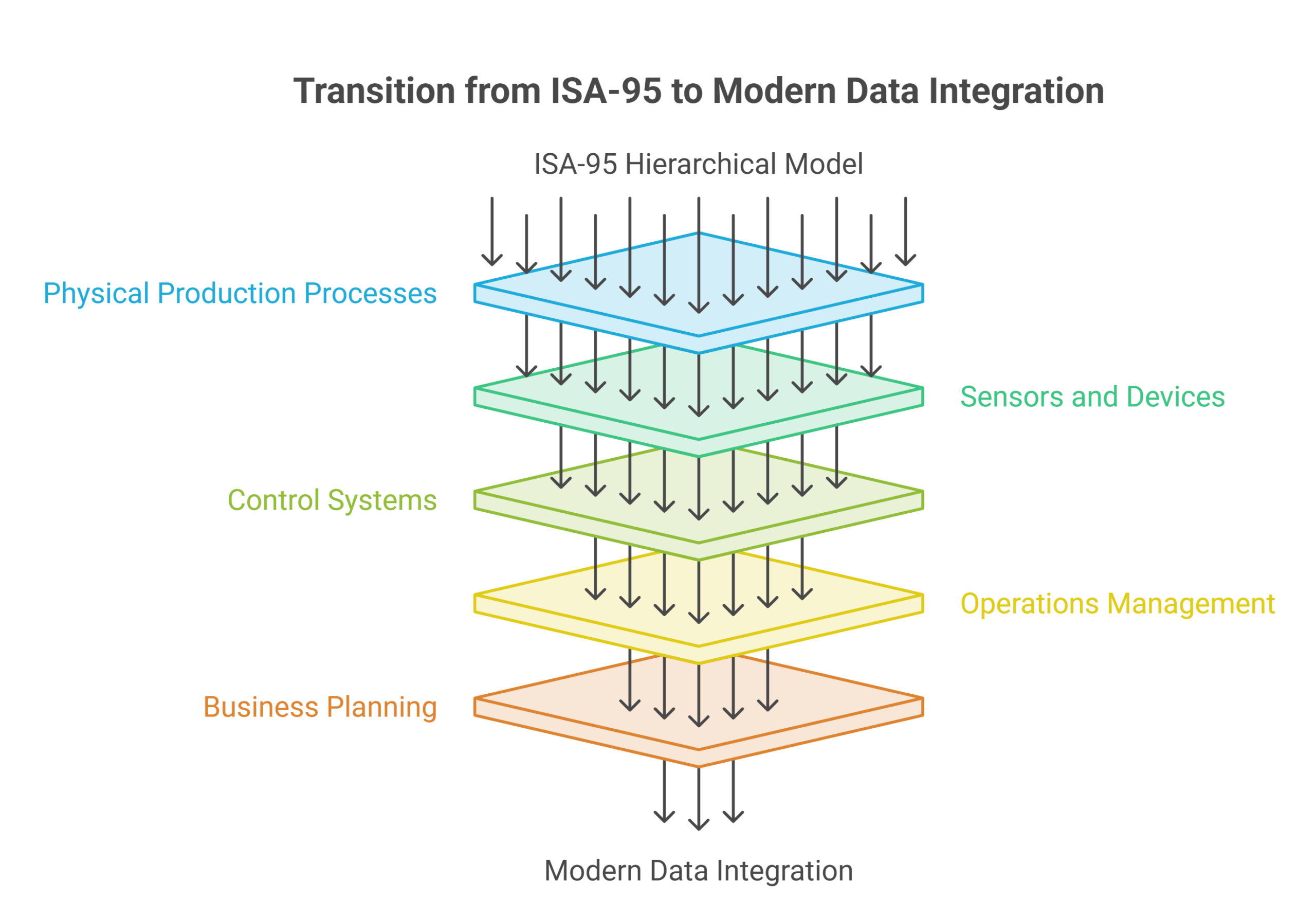
ISA-95 defines a hierarchical model that helps organize manufacturing environments:
- Level 0: Physical production processes
- Level 1: Sensors and devices that sense or manipulate the production process
- Level 2: PLCs, DCS, and supervisory control systems
- Level 3: Manufacturing operations management, including MES and related systems
- Level 4: Business planning and logistics, including ERP systems
ISA explains that the standard provides a framework for information exchange between manufacturing control functions and enterprise functions.
However, modern Industry 4.0 and smart manufacturing environments increasingly require more distributed, real-time data architectures. Rather than depending entirely on sequential system-to-system integrations, manufacturers can introduce technologies such as Unified Namespace (UNS), OPC UA, and MQTT to create more flexible data flows.
Standardizing Industrial Data with OPC UA, MQTT, and Unified Namespace
A Unified Namespace (UNS) can act as a centralized, real-time data layer where information from machines, production lines, applications, and enterprise systems is organized using consistent naming and semantic structures.
Instead of building numerous point-to-point integrations, industrial systems can publish data into a common information layer while authorized applications subscribe to the data they require.
1- OPC UA for Industrial Interoperability
OPC UA (Open Platform Communications Unified Architecture) is a platform-independent industrial communication standard designed to enable secure and reliable information exchange between devices and systems.
The OPC Foundation states that OPC UA can be applied across industrial sensors, actuators, control systems, MES, ERP, IIoT, and cloud-connected environments. It also provides information modeling capabilities that allow systems to represent the structure, behavior, and semantics of industrial data.
2- MQTT and Sparkplug for Industrial Messaging
MQTT (Message Queuing Telemetry Transport) is a lightweight publish/subscribe messaging protocol widely used in IoT and industrial environments.
For manufacturing applications, Sparkplug adds an industrial framework around MQTT by defining an OT-centric topic namespace, payload structure, and session-state management. The Eclipse Foundation describes Sparkplug as a specification designed specifically to support real-time industrial applications and SCADA environments.
Transforming Raw Machine Data into Structured Information
By combining industrial connectivity technologies with a well-designed data architecture, manufacturers can transform raw machine values into structured, contextual information.
For example, instead of working with an isolated value such as:
Modbus Register 40001
a manufacturing application can expose contextual information such as:
Enterprise/Texas_Plant/Assembly_Line_1/Robot_6/Joint_3/Temperature
This makes industrial data easier for analytics platforms, dashboards, AI models, MES applications, and enterprise systems to consume.
What Is MES Manufacturing Execution System Software?
MES manufacturing execution system software provides the digital infrastructure required to execute and monitor manufacturing processes. While an ERP system primarily focuses on business planning, orders, inventory, and financial operations, an MES focuses on how those plans are executed on the production floor.
Depending on the manufacturing environment, MES functionality can include production scheduling and dispatching, resource management, quality management, data collection, maintenance management, product tracking, genealogy, performance analysis, and document control. These capabilities correspond closely with the established functional areas associated with MES.

Implementing Edge AI in Smart Manufacturing Software
Once industrial data has been standardized, the next major challenge is latency, bandwidth, and processing requirements.
High-speed CNC machines, vibration sensors, cameras, and other industrial equipment can generate extremely large volumes of telemetry. Sending every raw data point to a centralized cloud environment can increase bandwidth requirements and introduce latency.
This is where Edge AI becomes valuable.
Why Edge AI Matters for Manufacturing
Instead of sending every raw sensor reading to the cloud, manufacturers can deploy machine learning models directly on Industrial PCs (IPCs), edge gateways, or other computing devices near the equipment.
For example, anomaly detection models can analyze vibration, acoustic, temperature, or machine-performance data locally.
The edge system can then send only:
- Machine health scores
- Detected anomalies
- Predictive maintenance alerts
- Aggregated production metrics
- Relevant events
to centralized cloud or enterprise systems.
Closed-Loop Industrial Automation
In more advanced implementations, an edge system can also participate in closed-loop decision-making.
For example, if an edge model detects an abnormal operating condition, the system could trigger an approved control workflow that adjusts machine parameters or initiates a safe shutdown.
However, any software that can influence physical machinery should be designed with appropriate safety controls, authorization mechanisms, and hardware-level protections. AI recommendations should not bypass established industrial safety systems.
Security and Compliance in Smart Manufacturing Software
Connecting operational technology to enterprise IT networks creates additional cybersecurity challenges.
Manufacturing organizations must protect not only business information but also production equipment, industrial control systems, worker safety, and operational continuity.
The National Institute of Standards and Technology (NIST) has specifically published guidance addressing cybersecurity for manufacturing industrial control system environments.
ISA/IEC 62443 for Industrial Cybersecurity
Enterprise-grade smart manufacturing software should be designed with relevant industrial cybersecurity standards in mind.
The ISA/IEC 62443 series provides requirements and processes for securing Industrial Automation and Control Systems (IACS) throughout their lifecycle. ISA describes the standard as a comprehensive framework covering asset owners, suppliers, integrators, and service providers.
Network Segmentation
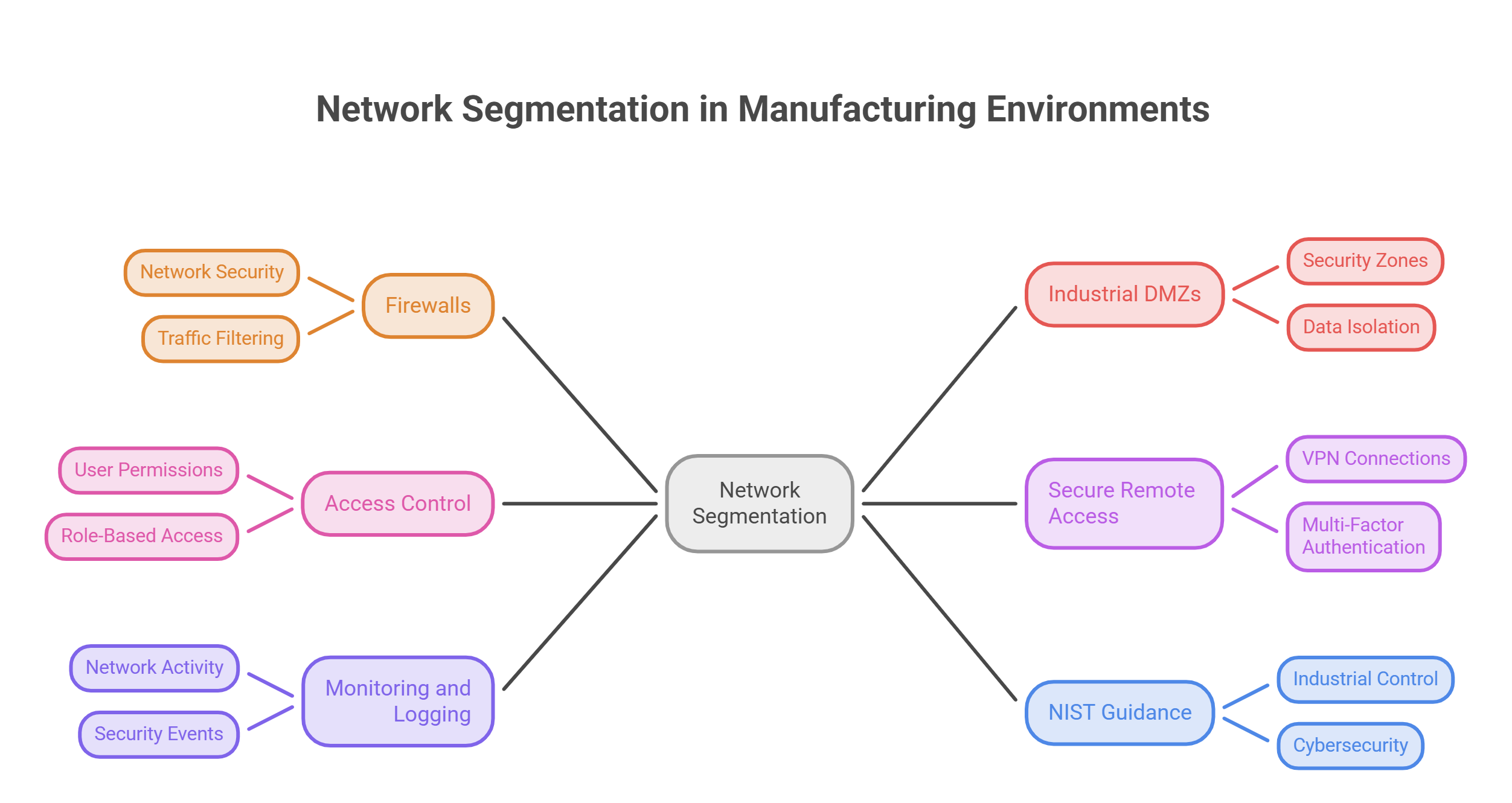
Manufacturing environments should maintain appropriate separation between enterprise IT systems and operational technology environments.
A properly designed architecture can use:
- Firewalls
- Industrial DMZs
- Network segmentation
- Access control
- Secure remote access
- Monitoring and logging
to reduce unnecessary exposure between IT and OT systems.
NIST’s manufacturing cybersecurity guidance provides additional information on protecting industrial control environments.
Zero Trust and Secure Edge-to-Cloud Communication
Modern manufacturing architectures can also incorporate Zero Trust principles, certificate-based authentication, TLS/mTLS, identity management, and tightly controlled device communication.
Edge devices should only communicate with authorized systems, while remote access should be authenticated, monitored, and restricted according to business requirements.
Write-Back Safety and Access Controls
Any system capable of sending commands back to industrial machinery requires additional safeguards.
Software-based control actions should incorporate:
- Role-Based Access Control (RBAC)
- Authentication and authorization
- Safety interlocks
- Edge-level validation
- Audit logging
- Fail-safe behavior
A cloud-based optimization model should not directly bypass a machine’s established safety architecture.
Build vs. Buy: Choosing the Right Manufacturing Software Strategy
When modernizing manufacturing operations, enterprise CTOs and COOs often face a fundamental decision: buy an existing platform or build a custom solution?
Off-the-Shelf Manufacturing Platforms
Commercial manufacturing platforms can provide faster deployment and established functionality.
However, highly specialized manufacturing environments may face challenges related to:
- Vendor lock-in
- Licensing costs
- Limited customization
- Proprietary ecosystems
- Integration constraints
- Specialized robotics workflows
Custom Smart Manufacturing Software
A custom approach can provide greater flexibility for manufacturers with unique production processes, specialized machinery, or complex integration requirements.
A capable development partner should understand both:
Modern software engineering
- Cloud-native architecture
- Microservices
- APIs
- AI/ML
- Data platforms
- Edge computing
Industrial engineering
- PLCs
- Industrial protocols
- Robotics
- Fieldbus systems
- SCADA
- MES
- Industrial networking
- Real-time systems
This combination is essential when building software that must operate across both enterprise IT and industrial OT environments.

What Is an MES System?
An MES system (Manufacturing Execution System) is software designed to manage, monitor, document, and optimize production activities in real time. It acts as a bridge between enterprise planning systems such as ERP and the physical manufacturing environment, giving production teams a more accurate view of what is happening on the factory floor.
A modern MES system for manufacturing can manage production orders, machine activity, material usage, quality checks, work-in-progress, operator activities, and product traceability. Instead of relying on spreadsheets, paper records, or disconnected applications, manufacturers can use MES software to create a centralized operational record of production.
Why Modular Architecture Matters
A modular architecture allows manufacturers to introduce new capabilities without replacing the entire technology stack.
For example, an enterprise may initially implement:
- Industrial connectivity
- Centralized data management
- Production monitoring
- Predictive maintenance
- Edge AI
- Automated optimization
This approach can reduce technology lock-in while allowing the manufacturing software platform to evolve alongside operational requirements.
Industrial Connectivity and Legacy PLC Integration
Manufacturers do not necessarily need to replace existing PLCs and machinery to begin their digital transformation.
Instead, industrial gateways and connectivity platforms can act as an integration layer between legacy equipment and modern software.
Using Industrial Gateways
Industrial gateways can communicate with legacy devices using protocols such as:
- Modbus
- PROFINET
- EtherNet/IP
- OPC UA
- Other vendor-specific protocols
The gateway can then normalize the information and expose it through modern interfaces such as OPC UA or MQTT.
For example, PTC’s Kepware provides connectivity between legacy and modern industrial devices and can transform proprietary protocols into standards such as OPC UA and MQTT.
Open-Source Edge Gateway Options
For organizations exploring open-source approaches, Eclipse Kura provides a framework for building IoT gateways and edge applications. The Eclipse Foundation describes Kura as a container for machine-to-machine applications running in service gateways, with capabilities for data services, networking, remote management, and cloud connectivity.
How MES Fits into Smart Manufacturing Technology
MES becomes even more powerful when integrated with modern smart manufacturing technology. Instead of operating as a standalone application, an MES can exchange information with PLCs, SCADA systems, industrial sensors, ERP platforms, IoT gateways, analytics platforms, and AI systems.
This creates a connected architecture where:
- Machines generate real-time operational data.
- Edge systems collect and process machine information.
- MES software manages production execution and traceability.
- AI and analytics identify patterns, anomalies, and optimization opportunities.
- ERP systems manage higher-level business planning and resources.
This combination allows manufacturers to move from simply collecting production data to using that data to make faster and more informed operational decisions.
Driving Real-World ROI with Smart Manufacturing Software
The ultimate measure of an industrial software investment is its effect on business performance.
A well-designed smart manufacturing software platform can help organizations improve visibility into production, identify equipment anomalies, reduce manual processes, and support data-driven operational decisions.
Potential business outcomes include:
- Reduced unplanned downtime
- Improved equipment utilization
- Faster identification of production issues
- Better predictive maintenance
- Improved production visibility
- More efficient resource utilization
- Faster operational decision-making
However, ROI should be measured against the manufacturer’s actual baseline rather than relying on generalized industry percentages. Metrics such as Overall Equipment Effectiveness (OEE), downtime, throughput, maintenance costs, scrap rates, and production cycle times provide a more reliable basis for evaluating results. By investing in a secure, scalable, and modern architecture, enterprise manufacturers can move from reactive operations toward data-driven, intelligent manufacturing environments.
How DevVibe Builds Smart Factory and Manufacturing Software
At DevVibe, we help manufacturers turn complex production environments into connected, intelligent digital systems. Our industrial technology expertise combines IoT-driven automation, AI, digital twins, analytics platforms, ERP integrations, and real-time operational systems to help factories improve visibility and operational control.
For manufacturers requiring a tailored approach, DevVibe can develop custom smart factory software, manufacturing execution solutions, industrial IoT platforms, and AI-powered automation systems that integrate with existing equipment and enterprise applications. Rather than forcing every manufacturer into the same software architecture, a custom development approach can be designed around existing workflows, machinery, data sources, production requirements, and future automation goals.
This makes custom development particularly useful for manufacturers operating brownfield facilities, specialized machinery, multiple production lines, or legacy industrial systems that need to work alongside newer smart manufacturing technologies.
FAQs
How do we integrate legacy PLCs with modern smart manufacturing software without replacing hardware?
Integration can be achieved through industrial gateways or Industrial PCs that communicate with legacy PLCs using protocols such as Modbus, PROFINET, or EtherNet/IP. The gateway can normalize the data and expose it through technologies such as OPC UA or MQTT for modern applications.
What is a Unified Namespace (UNS) in manufacturing?
A Unified Namespace is an architectural approach for organizing and sharing contextualized industrial and enterprise data through a common information layer. It can reduce the need for numerous point-to-point integrations and make real-time information easier for authorized applications to consume.
What is the difference between ISA-95 and a Unified Namespace?
ISA-95 provides a standardized framework and terminology for organizing manufacturing and enterprise functions and their information exchanges. A Unified Namespace is a modern data architecture approach that can sit across an organization’s systems to provide real-time, contextualized data access; it does not simply replace the ISA-95 standard.
How does Edge AI improve predictive maintenance in manufacturing?
Edge AI processes machine data close to the equipment instead of sending all raw telemetry to a centralized cloud. This can reduce latency and bandwidth requirements while enabling faster anomaly detection and maintenance decisions.
What protocols are commonly used in smart manufacturing software?
Common technologies include OPC UA, MQTT, Sparkplug, Modbus, PROFINET, and EtherNet/IP. The appropriate protocol depends on the equipment, network architecture, security requirements, and integration objectives.
What cybersecurity standards should smart manufacturing software consider?
Manufacturing organizations should consider relevant industrial cybersecurity frameworks and standards, including ISA/IEC 62443 and NIST guidance for manufacturing and industrial control systems. ISA/IEC 62443 specifically addresses cybersecurity requirements across the lifecycle of industrial automation and control systems.
Can AI directly control manufacturing machinery?
AI can participate in industrial control workflows, but direct control of physical machinery requires careful engineering. AI-generated decisions should operate within appropriate authorization, validation, safety, and fail-safe mechanisms rather than bypassing established machine safety controls.

Hamza is a technology-focused writer specializing in AI development, LLMs, software solutions, and workflow automation. He shares practical insights into how emerging technologies can solve complex business challenges.